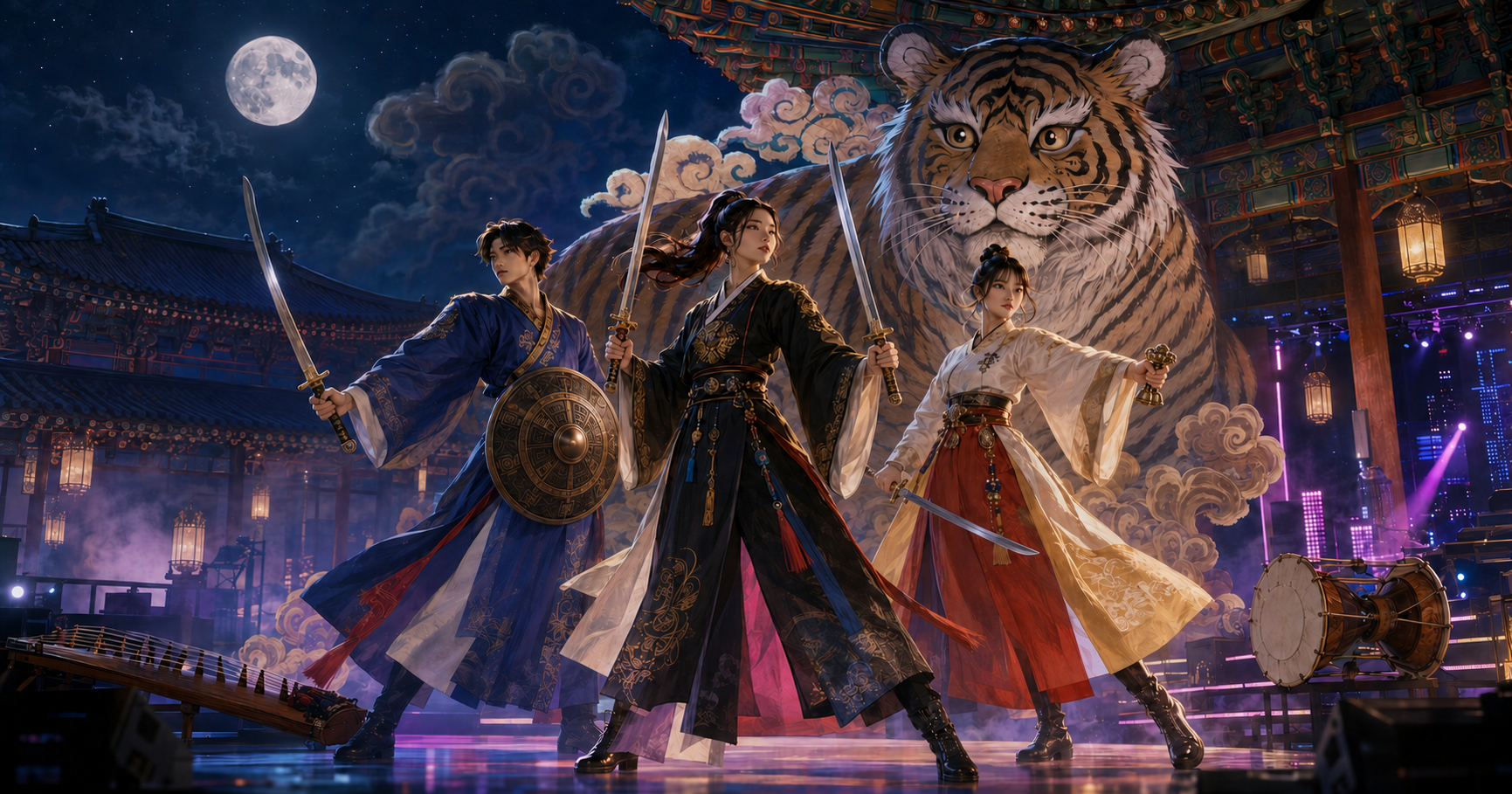
🏹 Beyond the Music and Action Lies a Rich Cultural Heritage
When people first watch KPop Demon Hunters, they’re usually captivated by the fast-paced action, catchy music, colorful visuals, and energetic performances. At first glance, it feels like a stylish fantasy inspired purely by modern K-pop culture.
But if you look a little closer, you’ll notice that its core ideas echo traditions that are centuries old. Although the film tells an original fictional story, its visual themes and spiritual motifs draw deeply from the ancient roots of Korean culture.
For international audiences, these elements offer a fascinating glimpse into the myths and traditions that have shaped Korea’s imagination for generations.
1. The Art of Banishing Evil: Roots in Korean Shamanism (Musok)
One of the central themes of the movie is the fierce battle between good and evil. This isn’t just a standard Hollywood trope—it has deep roots in Korean storytelling.
For centuries, Korean folklore has been filled with tales of wandering ghosts, protective deities, and rituals performed to drive away harmful forces.
🔮 What is Musok (무속)? Traditional Korean shamanism, known as Musok, features ancient ceremonies (Gut) intended to comfort restless spirits, pray for good fortune, and protect villages from misfortune.
While KPop Demon Hunters presents these ideas in a modern, stylized fantasy jacket, the concept of spiritual guardians fighting dark forces is directly inherited from this ancient spiritual history.
2. Tigers: The Mystical Mountain Guardians of Folklore
If you’ve ever explored Korean culture, you’ve probably noticed how often tigers appear. In Korean folklore, the tiger isn’t simply a dangerous apex predator. It is a sacred guardian, a mountain spirit (Sanshin), and sometimes even a humorous, trickster character in traditional folk tales.
The Inspiration: Ancient Korean folk paintings, known as Minhwa (민화), often portray tigers with exaggerated, cross-eyed, or comical expressions that make them look both powerful and approachable.
The Modern Twist: Whenever modern Korean stories include mystical animals or guardian figures, they instinctively draw inspiration from this long, affectionate relationship between humans and tigers.
3. Visual Storytelling: The Aesthetics of Obangsaek and Hanbok
The movie’s vibrant visual identity immediately reminds Korean viewers of traditional royal aesthetics.
Saekdong-jeogori (a traditional Korean jacket with vibrant, multi-colored striped sleeves)
The bright, striking combinations of red, blue, yellow, white, and black resemble Obangsaek (오방색)—the five traditional colors that symbolize different directions, natural elements, and philosophical ideas in Korean cosmology.
Saekdong-jeogori (a traditional Korean jacket with vibrant, multi-colored striped sleeves)
Likewise, the costume designs and flowing, dynamic silhouettes during action scenes beautifully evoke the elegance of Hanbok (한복), Korea’s traditional clothing. Rather than copying historical garments directly, modern creators reinterpret these classic elements in fresh, imaginative ways.
4. Music That Bridges the Past and the Present
Although the soundtrack celebrates modern K-pop, the broader trend in contemporary Korean music reflects a beautiful fusion of eras.
In recent years, Korean artists have increasingly blended traditional instruments—such as the stringed Gayageum (가야금), the hourglass drum Janggu (장구), and thunderous Samulnori (사물놀이) percussion—with modern pop, hip-hop, and electronic beats.
This creative fusion has become a defining characteristic of modern K-culture: respecting the past while constantly reinventing it.
🎬 Why These Ancient Details Matter Today
One reason KPop Demon Hunters resonates so deeply with global audiences is that it feels both ultra-modern and timeless. The story embraces global pop trends while quietly standing on a foundation built over thousands of years.
Ancient myths don’t disappear in Korea; they simply find vibrant new ways to be told.
KPop Demon Hunters isn’t a rigid history lesson. Instead, it uses fragments of Korean folklore, symbolism, and spirituality as fuel for an exciting modern fantasy. Long after the music ends and the final battle is won, it leaves international viewers asking a fascinating question: “What parts of this story come from real Korean culture?”
And that very question is the beginning of an unforgettable journey into Korea’s rich cultural heritage.
“Want to dive deeper into Korean folk culture? Click the link below!”