
Have you ever looked at a writing system and felt it was a beautiful work of modern art?
If you’ve ever walked the vibrant streets of Seoul, scrolled through the lyrics of a K-pop hit, or watched a historical K-drama, you’ve definitely encountered Hangeul (한글)—the Korean alphabet. To the untrained eye, it looks like a sleek, minimalist grid of circles and lines. But to linguists and historians worldwide, Hangeul is celebrated as one of the most scientifically designed and intellectually perfect writing systems in human history.
What makes Hangeul truly miraculous, however, is its origin story. Unlike English, French, or Japanese, which evolved slowly over thousands of years through cultural mixing, Hangeul did not happen by accident. We know exactly who created it, the precise year it was finished, and the profound, dramatic reason why it was born.
It is the story of a visionary king who waged a silent war against his own government to give his poorest subjects a voice.
1. The Silent Kingdom: The Struggle of the Common People
To understand why Hangeul was a revolutionary invention, we must first look at the silent tragedy of 15th-century Korea (then known as the Joseon Dynasty).
During this era, Korea did not have its own script. Instead, the nation relied on Classical Chinese characters (Hanja) to record its laws, history, and daily transactions. But Hanja was never meant for the Korean language. Chinese and Korean belong to entirely different language families; their grammar, word order, and sounds are completely incompatible. Writing Korean using Chinese characters was like trying to write English using only Egyptian hieroglyphs.
To understand why Hangeul was a revolutionary invention, we must first look at the silent tragedy of 15th-century Korea (then known as the Joseon Dynasty).
During this era, Korea did not have its own script. Instead, the nation relied on Classical Chinese characters (Hanja) to record its laws, history, and daily transactions. But Hanja was never meant for the Korean language. Chinese and Korean belong to entirely different language families; their grammar, word order, and sounds are completely incompatible. Writing Korean using Chinese characters was like trying to write English using only Egyptian hieroglyphs.
For the average citizen—the farmers, the fishermen, the weavers—learning to read and write was an impossible dream. This illiteracy had devastating consequences:
Injustice: A peasant farmer could be cheated out of his land with a forged contract because he couldn’t read the text.
Danger: When the government posted signs warning of diseases or new laws, the commoners remained completely unaware.
Unvoiced Grief: If someone suffered an abuse of power, they could not write a petition to the court to demand justice.
The vast majority of the population lived and died in a world of enforced silence.
Enter King Sejong: The Humanist on the Throne

In 1418, a young man ascended the throne who would change the course of Korean history forever. His name was King Sejong (세종대왕). Today, Koreans venerate him as “King Sejong the Great,” and his portrait gracing the 10,000-won bill is a daily reminder of his legacy.
Sejong was a true Renaissance man born long before the Renaissance reached its peak in Europe. He was a scientist, an astronomer, a musician, and a legal reformer. But above all, he was a monarch deeply moved by the suffering of his people.
Whenever Sejong traveled outside the palace walls, he saw the struggles of his illiterate subjects. He realized that a society where only 1% of the population holds the key to knowledge can never truly flourish. In the preface to his secret project, he penned these legendary words:
“Being illiterate, the common people, even when they have something they wish to say, are ultimately unable to express their feelings. Being touched by this pity, I have newly made twenty-eight letters…”
Sejong decided to do the unthinkable: he would personally design a brand-new, incredibly simple writing system from scratch.
The Code of the Cosmos: The Scientific Design of Hangeul
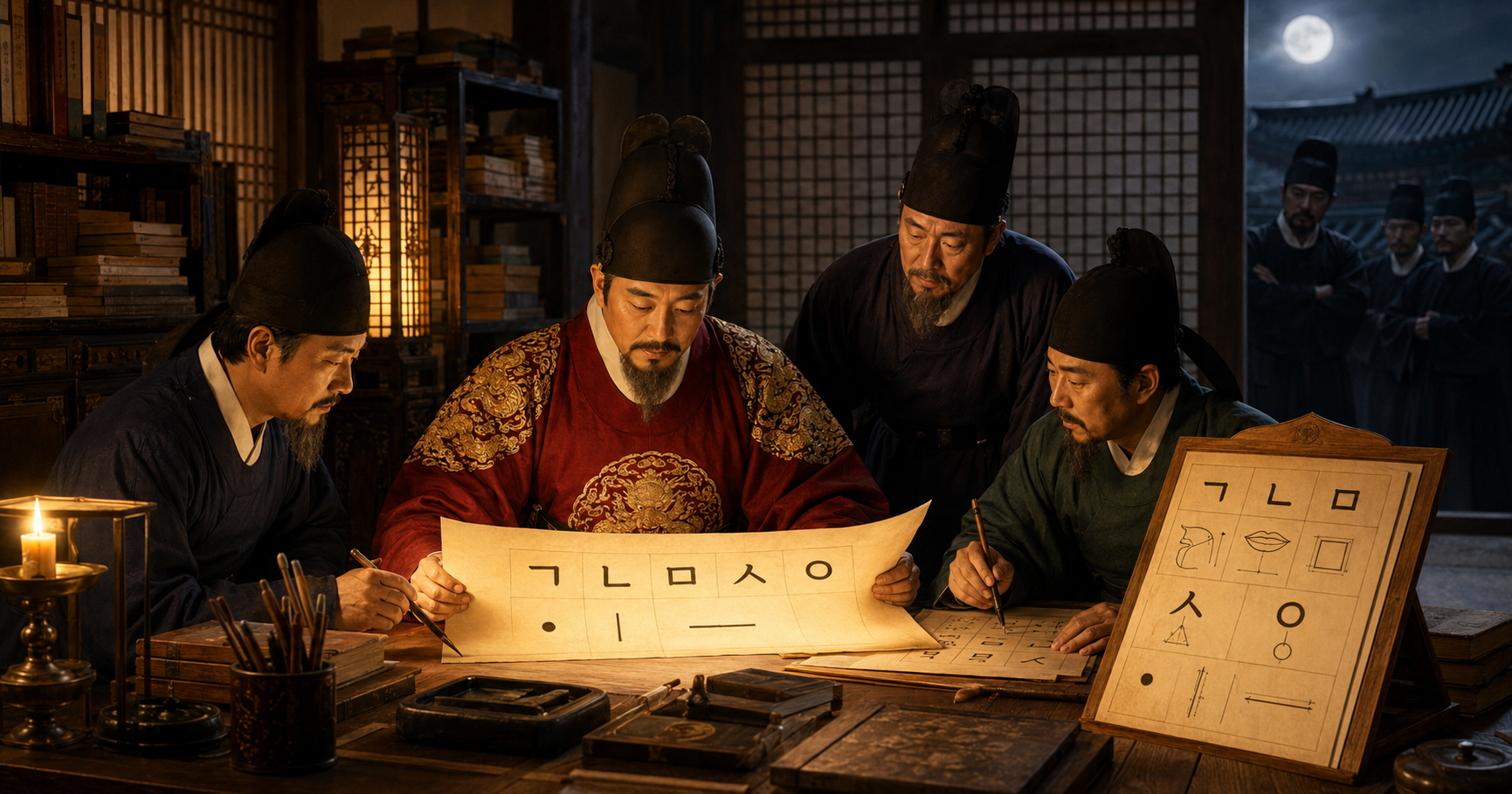
In 1443, King Sejong and a small, trusted group of royal scholars finally completed the alphabet. They named it Hunminjeongeum (훈민정음), which translates to: “The Correct Sounds for Instructing the People.”
Click the image below to learn more about Hunminjeongeum.

The brilliance of Hangeul lies in its utter simplicity and logical structure. Sejong did not just draw random shapes; he based the alphabet on anatomy and philosophy.
🧠 The Consonants: Mimicking the Mouth
Unlike Western alphabets, where the shape of the letter ‘L’ or ‘B’ has nothing to do with how the sound is made, Hangeul’s consonants are visual diagrams of the human speech organs.
- ㄱ (g/k): Mimics the tongue blocking the throat.
- ㄴ (n): Represents the tip of the tongue touching the upper gums.
- ㅁ (m): Represents the outline of the lips.
- ㅅ (s): Represents the shape of the teeth.
- ㅇ (ng/silent): Represents the open throat.
By looking at the letters, a reader can actually visualize how to shape their mouth to pronounce the sound.
🌌 The Vowels: The Harmony of the Universe
For the vowels, Sejong turned to Eastern cosmology, representing the three core components of the universe:
- Heaven ( ㆍ ): A simple dot (which later evolved into a short line).
- Earth ( ㅡ ): A flat, horizontal line.
- Human ( ㅣ ): A standing, vertical line.
By combining these three simple elements (for example, combining Heaven and Earth to make ㅗ or ㅜ), Sejong created a highly flexible system capable of representing almost any vocal sound.
Because the system was built on pure logic, it was incredibly easy to learn. A popular historical saying perfectly summarizes its accessibility:
“A wise man can learn it before the morning is over; a foolish man can learn it in ten days.”
The Palace Rebellion: The Battle for the Alphabet
You might expect that the entire kingdom rejoiced at this miraculous invention. In reality, it triggered one of the most intense political battles of Sejong’s reign.
The conservative noblemen, led by a high-ranking scholar named Choe Man-ri, were absolutely horrified. They saw Hangeul as a direct threat to their power and status. They launched furious protests, presenting long, angry petitions to the king. Their arguments were cruel but clear:
- Loss of Power: If peasants could read and write, they would no longer obey the nobility blindly.
- Cultural Identity: They argued that abandoning Chinese characters would make Korea look “barbaric” in the eyes of the powerful Ming Dynasty of China.
But King Sejong stood his ground. He fiercely debated his ministers, arguing that the dignity and survival of his people were far more important than the pride of the ruling class. In 1446, despite the heavy political resistance, Sejong officially published the Hunminjeongeum. He had successfully democratized literacy.
Hangeul’s Modern Triumph: A Global Cultural Superpower
In the centuries following Sejong’s death, elite scholars tried repeatedly to suppress Hangeul, calling it a “women’s script” or “vulgar letters.” Yet, the alphabet refused to die. It was kept alive by women, commoners, and novelists who recognized its beauty.
When Korea gained independence in the mid-20th century, Hangeul was officially adopted as the primary national script. Today, thanks to King Sejong’s brilliant design, South Korea boasts one of the highest literacy rates in the world—nearly 100%. Every year on October 9th, Koreans celebrate a national holiday called “Hangeul Day” to honor their beloved king.
Even the United Nations has recognized this achievement, creating the UNESCO King Sejong Literacy Prize, which honors organizations worldwide that fight illiteracy.
As Hallyu (the Korean Wave) sweeps across the globe, millions of people from New York to London and Paris are learning Hangeul. And just as Sejong intended 600 years ago, modern learners find that they can master reading the Korean alphabet in a single afternoon.
King Sejong’s creation of Hangeul was not just a linguistic breakthrough. It was a profound act of love, a triumph of science over tradition, and a lasting reminder that knowledge, communication, and power belong to everyone, not just the privileged few.
What do you think of King Sejong’s vision? Have you ever tried writing your own name in Hangeul? Let us know your thoughts in the comments below!