
Most writing systems developed gradually. Their earliest creators did not leave behind a manual explaining why each letter looked the way it did.
Hangeul is different.
In 15th-century Korea, King Sejong created a new writing system and published a book explaining its purpose and use. An expanded section described how the letters represented speech sounds, why they had particular shapes, and how they could be combined into syllables.
That book is the Hunminjeongeum Haerye (훈민정음 해례), commonly called the “Explanations and Examples” edition of Hunminjeongeum.
It is more than an old Korean book. It is a surviving design document for an entire alphabet—and one of the clearest records of how a writing system was deliberately constructed.
What Is the Hunminjeongeum Haerye?
Hunminjeongeum (훈민정음, 訓民正音) can be translated as “The Proper Sounds for the Instruction of the People.”
The name originally referred both to the new letters created by King Sejong and to the text that introduced them. Today, the writing system is generally called Hangeul, while Hunminjeongeum usually refers to the original proclamation or book.
The word haerye (해례, 解例) means “explanations and examples.” The Hunminjeongeum Haerye therefore refers to the edition containing detailed explanations of the new script.
A useful distinction is:
- Hangeul: The Korean writing system used today
- Hunminjeongeum: The original name of the writing system and the text that introduced it
- Hunminjeongeum Haerye: The edition containing the original text, detailed commentary, examples, and a postface
The surviving Haerye Edition was published in 1446, during the reign of King Sejong (세종대왕), the fourth king of the Joseon dynasty.
Why King Sejong Created New Letters
Koreans already had a spoken language long before Hangeul existed. The difficulty lay in writing it.
Educated Koreans generally wrote with Chinese characters. These characters could be used to record Korean, but Chinese and Korean have different grammatical structures and sound systems. Learning to read and write Chinese characters also required years of study, putting literacy beyond the reach of much of the population.
People could speak Korean perfectly well while remaining unable to record a personal thought, read an official notice, or express a grievance in writing.
King Sejong described this problem directly in the opening of Hunminjeongeum. He explained that Korea’s language differed from that of China and did not correspond smoothly with Chinese writing. He then stated that he had created 28 new letters so people could learn them easily and use them in daily life.
This introduction is remarkable for its practical concern. The new script was not presented merely as a scholarly experiment. It was intended to help ordinary people communicate.
Hangeul is sometimes described as having been created by King Sejong and the scholars of the Hall of Worthies together. The historical record, however, attributes the creation of the letters directly to the king. Scholars including Jeong In-ji later participated in preparing the explanations, examples, and postface found in the Haerye Edition.
Created in 1443, Published in 1446
Two dates often appear in explanations of Hangeul, and they refer to different stages.
King Sejong completed the new letters in 1443, according to the traditional Korean calendar used in the royal records. The writing system was then formally introduced with its explanatory material in 1446.
Put simply:
- 1443: King Sejong completed the new writing system.
- 1446: Hunminjeongeum, including the Haerye explanations, was published.
This is why some sources say that Hangeul was created in 1443 while others emphasize its promulgation in 1446. Both dates are meaningful, but they do not describe the same event.
A Manual for Designing an Alphabet
What makes the Hunminjeongeum Haerye extraordinary is the way it explains the logic behind the letters.
The book does not simply provide a chart and tell readers to memorize it. It connects the visual forms of the letters to the physical production of sound.
Consonants Based on Speech Organs
The basic consonants were designed to represent the position or shape of the mouth and throat when making particular sounds.
For example:
- ㄱ represents the tongue blocking the back of the mouth.
- ㄴ reflects the tongue touching the upper gum.
- ㅁ resembles the shape of the mouth.
- ㅅ represents the shape of the teeth.
- ㅇ reflects the open throat.
Additional strokes were then added to some basic forms to create related consonants. This allowed visual similarities between letters to reflect relationships between their sounds.
A learner looking at ㄱ and ㅋ, for example, is not seeing two completely unrelated symbols. Their shapes indicate that the sounds belong to the same family, with ㅋ carrying an added burst of air.
The system is not a perfect anatomical drawing, nor should modern readers expect every letter to function exactly as it did in the 15th century. Its importance lies in the underlying idea: the written form was systematically connected to human speech.
Vowels and the Three Fundamental Elements
The original vowel design used three basic elements associated with traditional East Asian philosophy:
- ㆍ represented heaven.
- ㅡ represented earth.
- ㅣ represented the human being.
These forms were combined and positioned in different ways to create vowels. The system joined observations about sound with a philosophical understanding of the relationship between heaven, earth, and humanity.
Several original letters are no longer used in modern Korean. The script began with 28 letters, while contemporary Hangeul commonly uses 24 basic letters: 14 consonants and 10 vowels.
This change does not mean that the original design failed. Languages evolve, pronunciations change, and writing systems adapt with them.
Why Hangeul Letters Form Square Blocks
Foreign readers sometimes assume that each Korean syllable block is a single character like a Chinese character. It is actually a group of alphabetic letters arranged inside an imaginary square.
For example, the word 한글 (Hangeul) contains two syllable blocks:
- 한 combines ㅎ, ㅏ, and ㄴ.
- 글 combines ㄱ, ㅡ, and ㄹ.
The letters are written in compact syllable units rather than along one continuous horizontal line. Depending on the vowel, they may be placed from left to right or from top to bottom.
This structure gives Korean writing its distinctive appearance. A printed page can look like a field of square characters, but every block can be separated into individual consonants and vowels.
The Haerye explains principles for initial, medial, and final sounds—the parts that come together to form a Korean syllable. This systematic combination allows a relatively small number of letters to represent a vast number of spoken words.
The Six Explanatory Sections
The Haerye portion is traditionally divided into six sections:
- Explanation of the Design of the Letters
- Explanation of Initial Sounds
- Explanation of Medial Sounds
- Explanation of Final Sounds
- Explanation of Combining the Letters
- Examples of the Uses of the Letters
These sections reveal that the creators were thinking about more than individual symbols. They examined the whole process by which speech becomes writing: how sounds begin, how vowels function within syllables, how syllables end, and how letters work together.
Jeong In-ji’s postface adds historical context and explains the value of the new script. Together, these materials allow modern linguists and historians to study not only what the letters were, but also the reasoning behind them.
Without the Haerye, scholars could still see that Hangeul was systematic. With it, they can read the system’s original explanation.
A Book That Disappeared for Centuries
The basic text of Hunminjeongeum survived in later records and editions, but the detailed Haerye Edition was long believed to have been lost.
Then, in 1940, a copy was discovered in an old house in Andong, North Gyeongsang Province. This was during the Japanese colonial period, when Korean language and cultural identity faced intense pressure.
The discovery gave scholars direct access to explanations that had been unavailable for centuries. It confirmed important principles behind the shapes of the consonants and vowels and transformed the modern study of Hangeul.
The surviving volume later became known as the Kansong copy, after collector and cultural preservationist Jeon Hyeong-pil, whose pen name was Kansong. It is preserved by the Kansong Art Museum in Seoul.
The volume consists of 33 leaves. Its first pages suffered some damage, and parts were restored after its discovery. For that reason, researchers distinguish between the original material and later repairs when studying the artifact.
Why UNESCO Recognized It
The Hunminjeongeum manuscript was added to UNESCO’s Memory of the World Register in 1997.
This is sometimes confused with UNESCO World Heritage status, which is generally associated with places such as palaces, temples, historic districts, and natural landscapes. The Memory of the World Programme focuses instead on documentary heritage: manuscripts, archives, books, films, and other records of lasting global importance.
UNESCO describes the manuscript as containing King Sejong’s proclamation, the Haerye explanations prepared by scholars of the Hall of Worthies, and Jeong In-ji’s postface. It remains in the collection of the Kansong Art Museum.
Its international value comes from something rare: the manuscript records when the alphabet was introduced, why it was needed, and how its design worked.
Many cultures possess ancient writing traditions. Very few possess such a detailed contemporary explanation of an alphabet’s planned creation.
More Than a Story About Easy Letters
Hangeul is often praised because it can be learned relatively quickly. That is important, but the Haerye reveals a deeper achievement.
The script was designed around a careful analysis of spoken sound. It organized related consonants visually, combined letters into syllable blocks, and offered a system flexible enough to record Korean more directly than Chinese characters could.
Its creation also reflected a view of literacy as a practical social need. King Sejong’s preface did not argue that writing should remain the possession of an educated minority. It expressed concern for people who had something to say but lacked a convenient way to put it into writing.
That goal was not achieved immediately. Chinese characters remained important for centuries, and Hangeul was sometimes dismissed by members of the elite. Its wider social role expanded gradually, especially through vernacular literature, religious texts, education, newspapers, language reform, and modern mass literacy.
The history is therefore more complicated than a single royal announcement instantly making everyone literate. The invention supplied the tool; Korean society spent centuries expanding its use.
What International Visitors Can Notice Today
The influence of Hangeul is visible everywhere in modern Korea: subway signs, restaurant menus, apartment notices, smartphone messages, advertisements, packaging, and street names.
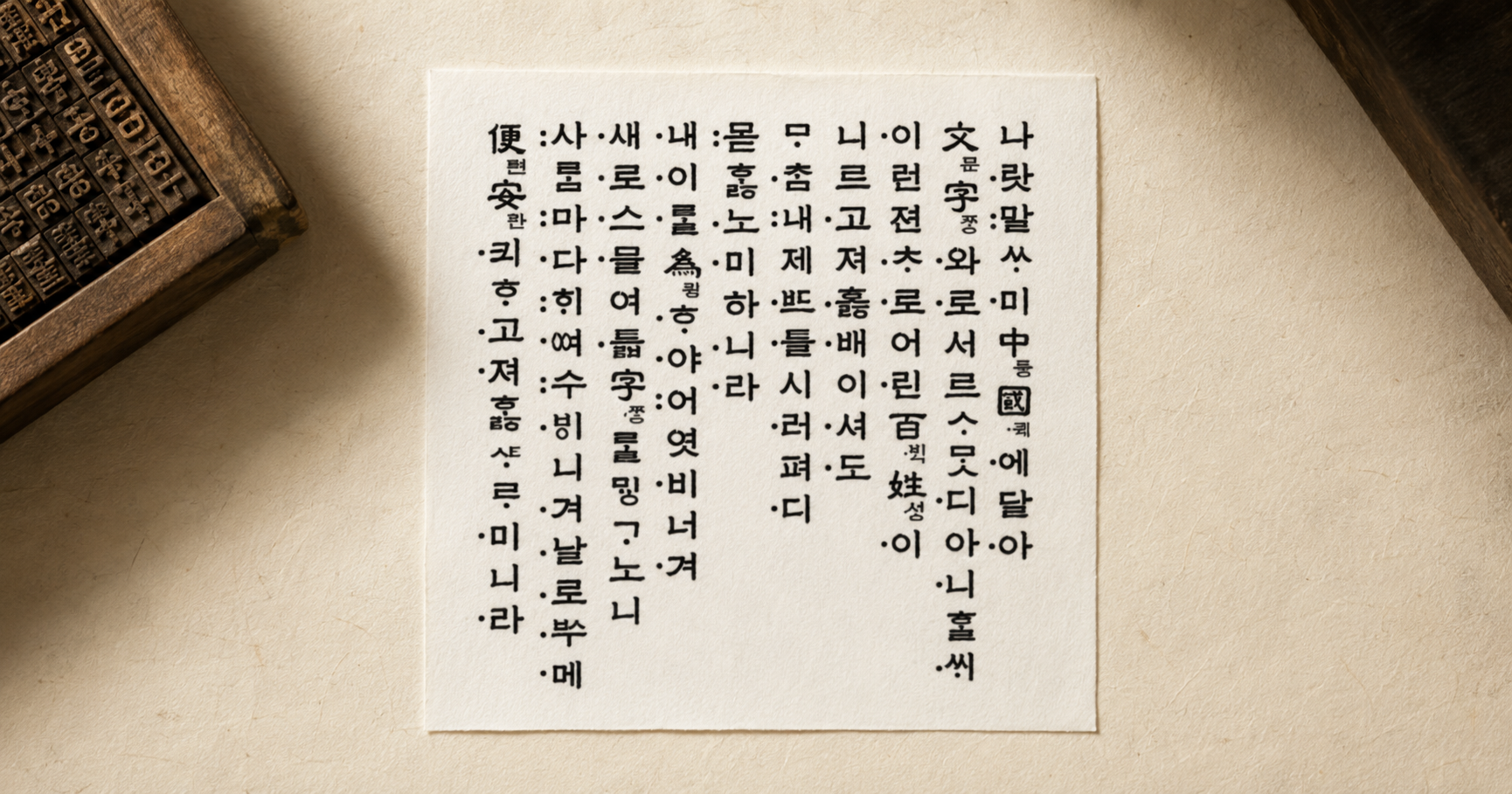
Visitors may also encounter the famous opening pages of Hunminjeongeum on museum walls, souvenirs, clothing, and graphic designs. These images are not ordinary samples of modern Korean writing. They reproduce or reinterpret a 15th-century text originally written largely in Classical Chinese, with early Hangeul used to explain the new letters and sounds.
The original manuscript is therefore not as immediately readable to a modern Korean as a contemporary newspaper. The vocabulary, spelling, letter forms, and written context have changed substantially.
Understanding that difference prevents a common cultural misunderstanding. Hangeul remains a living writing system, but the Hunminjeongeum Haerye is a specialized historical work that requires interpretation even for most Korean readers.
Conclusion
The Hunminjeongeum Haerye matters because it preserves the thinking behind Hangeul.
It shows that the Korean alphabet was not a random collection of convenient symbols. Its letters were connected to speech organs, its vowels reflected both sound and philosophy, and its syllable blocks were governed by clear rules of combination.
The manuscript also preserves King Sejong’s concern for people unable to express themselves easily in writing. That human purpose is what gives the technical design its lasting cultural meaning.
When visitors see Hangeul on a Seoul subway sign or a café menu, they are looking at the modern descendant of a system documented nearly six centuries ago. The letters have changed, and Korean society has changed with them. Yet the central idea remains recognizable: writing should help people turn their spoken language into something they can share.
Official References
- UNESCO Memory of the World: Hunminjeongum Manuscript
- Korea Heritage Service: Hunminjeongeum
- Korea Heritage Service: Memory of the World
Frequently Asked Questions
What does Hunminjeongeum mean?
Hunminjeongeum means “The Proper Sounds for the Instruction of the People.” It was the original name of the writing system now known as Hangeul and the title of the text that introduced it.
Is Hunminjeongeum the same as Hangeul?
The names are closely related but are not always interchangeable today. Hangeul usually means the modern Korean alphabet, while Hunminjeongeum generally refers to its original name or the 1446 publication.
What does Haerye mean?
Haerye means “explanations and examples.” The Haerye section explains how the letters were designed, how sounds were classified, and how letters were combined.
Did King Sejong create Hangeul by himself?
Historical records directly credit King Sejong with creating the new letters. Scholars of the Hall of Worthies helped prepare the detailed explanations, examples, and postface associated with the Haerye Edition.
Where is the original manuscript kept?
The surviving Kansong copy is preserved by the Kansong Art Museum in Seoul. It was added to UNESCO’s Memory of the World Register in 1997.