
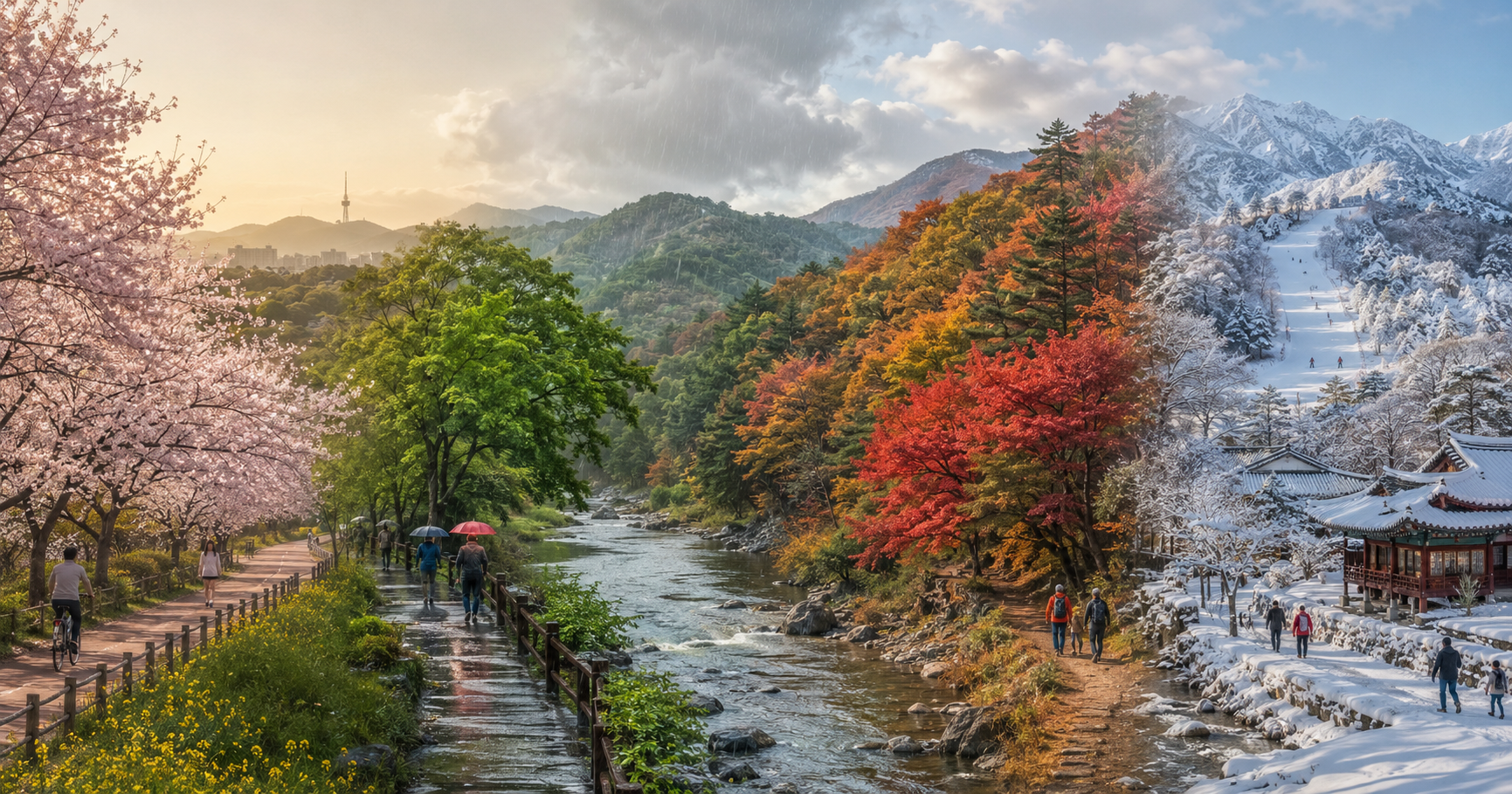

South Korea is a country where the same street can look completely different every few months. Cherry blossoms brighten it in spring, umbrellas fill it during the summer rains, red and gold leaves cover it in autumn, and snow may turn it white in winter.
These changes are more than attractive scenery. South Korea’s weather affects what people wear, eat, do on weekends, and even talk about each morning. Spring brings flowers but also the possibility of yellow dust. Summer arrives with heat, humidity, and jangma, the Korean rainy season. Autumn draws people into the mountains, while winter opens ski slopes and outdoor ice rinks.
Anyone living in or visiting Korea can experience four recognizable seasons. However, each season has pleasures as well as inconveniences—and the timing and intensity of the weather can vary from year to year.
Understanding South Korea’s Four Seasons
South Korea lies in the temperate zone and experiences spring, summer, autumn, and winter. The contrast between the hottest and coldest parts of the year can feel dramatic, particularly in inland areas such as Seoul.
The country is relatively small, but its weather is not identical everywhere. Seoul and the central region generally have colder winters than southern coastal cities such as Busan. Mountainous areas become colder and receive snow earlier, while Jeju Island has a milder climate influenced by the surrounding sea.
The seasons also do not follow an exact calendar. A warm spell can make March feel like spring before cold air suddenly returns. Summer heat sometimes continues well into September, and the first snow may arrive early in the mountains but much later in southern cities.
Climate change is also affecting familiar seasonal patterns. Heat waves, heavy rainfall, and unusually warm periods can make the transitions less predictable than they once seemed. Korea still has four seasons, but travelers should rely on a recent forecast rather than assuming every year will follow the same schedule.
Spring: Flowers, New Beginnings, and Yellow Dust
Spring usually begins to make itself felt in March, although mornings may remain cold. Heavy winter coats gradually disappear, café terraces reopen, and people return to walking paths, bicycle routes, and neighborhood parks.
The change first appears in small signs. New leaves emerge along city streets, magnolias bloom, and flower markets become more colorful. Cherry blossoms then spread northward across the country as temperatures rise.
For many Koreans, spring means finding time to see the blossoms before they fall. Parks, university campuses, palace grounds, lakesides, and riverside paths become popular places for photographs and evening walks. Famous locations can be crowded, but flowering trees are so common that a quiet neighborhood street may offer an equally memorable scene.
Spring weather can be pleasant, but it changes quickly. A sunny afternoon may feel warm, while the evening still requires a jacket. Layered clothing is usually more useful than dressing for only one temperature.
What Is Yellow Dust?
One less romantic part of spring is hwangsa (황사), commonly translated as “yellow dust.” It refers to fine soil and dust carried toward the Korean Peninsula by winds from dry regions of northern China and Mongolia.
Yellow dust is not present every day throughout spring, and its severity varies considerably. On affected days, the sky may look hazy, distant buildings become less clear, and air-quality alerts may appear on smartphones and public information displays.
Yellow dust and fine particulate pollution are related air-quality concerns, but they are not exactly the same phenomenon. Because both can affect breathing and outdoor comfort, people commonly check air-quality information before exercising or opening their windows.
Visitors with asthma, respiratory conditions, or sensitive eyes may want to limit strenuous outdoor activity when official advisories are issued. A well-fitting protective mask can also be useful on poor-air-quality days.
Image Suggestion: Cherry blossoms along a Korean riverside path with people walking beneath the trees.
ALT Text: People walking under cherry blossoms beside a river in South Korea during spring
Summer: Heat, Humidity, and the Jangma Rains
Summer in Korea is hot and often humid. By June, light clothing, handheld fans, iced drinks, and air-conditioned indoor spaces become part of everyday life.
The season is not simply a long series of sunny days. Early and midsummer are influenced by jangma (장마), the rainy period created by a seasonal weather front around the Korean Peninsula.
Calling jangma a “monsoon” helps international readers understand it, but the experience may differ from what they imagine. It does not necessarily rain continuously every day. There may be several wet days, a pause, and then another period of heavy rain.
A summer morning can begin quietly and end with an intense downpour. Subway entrances fill with wet umbrellas, convenience stores place umbrella covers near their doors, and riverside paths may be temporarily closed when water levels rise.
Rainfall can also be highly localized. One part of a city may receive heavy rain while another area remains comparatively dry. This is why Koreans often check short-term forecasts and rain radar before leaving home.
Life During the Rainy Season
An umbrella is essential, but it may not be enough during a strong summer storm. Waterproof shoes or sandals, quick-drying clothing, and a cover for luggage can make travel much easier.
Heavy rain can disrupt hiking, camping, driving, and outdoor festivals. Mountain trails may become slippery, and valleys can be dangerous when water levels rise rapidly. Official warnings and local access restrictions should always take priority over travel plans.
After the main rainy period, the hottest part of summer often follows. High humidity can make the temperature feel more uncomfortable than the number on the thermometer suggests. At night, the heat may remain trapped between apartment buildings and paved streets.
People respond by visiting beaches, water parks, shaded mountain valleys, and indoor shopping centers. Along the Han River, summer evenings bring cyclists, runners, picnickers, and families waiting for the air to cool after sunset.
Popular summer foods also reflect the weather. Cold noodles such as naengmyeon offer relief from the heat, while many Koreans eat warming dishes such as samgyetang, chicken soup with ginseng, based on the traditional idea of restoring energy during the hottest days.
Image Suggestion: A Seoul street during summer rain, with pedestrians carrying umbrellas and reflections on the pavement.
ALT Text: Pedestrians carrying umbrellas on a rainy summer street in Seoul
Autumn: Clear Skies and Mountains of Color
Autumn is often considered one of the most comfortable seasons in Korea. The humidity decreases, the air feels cooler, and many days bring blue skies and pleasant temperatures.
After the intensity of summer, the first cool morning can feel like a relief. People begin wearing light jackets, cafés introduce seasonal drinks, and families make plans for outdoor weekends.
The most celebrated autumn sight is danpung (단풍), the changing color of the leaves. Maple trees turn red, ginkgo trees become bright yellow, and forested mountains display layers of orange, gold, brown, and green.
Because mountains cover a large part of South Korea, autumn foliage is not limited to remote areas. It can be seen in national parks, palace gardens, university campuses, apartment complexes, and ordinary city streets.
Ginkgo trees create some of the most striking urban scenes. Their golden leaves can cover sidewalks almost overnight. However, the fruit of female ginkgo trees has a strong smell when crushed—an everyday autumn detail that beautiful travel photographs rarely mention.
Autumn Hiking Culture
Hiking is popular throughout the year, but autumn is a particularly busy season on Korean mountains. Trails in places such as Seoraksan, Naejangsan, and Bukhansan can become crowded when the foliage reaches its peak.
The atmosphere is often social rather than solitary. Groups of friends arrive early, families share food at rest areas, and hikers exchange brief greetings on the trail. Mountains are treated not only as scenic destinations but also as accessible spaces for regular exercise.
Visitors should not underestimate a trail because its starting point is close to a subway station or city neighborhood. Some Korean mountains have steep rocky sections, and temperatures can drop quickly at higher elevations. Comfortable shoes, water, and an extra layer remain important.
Autumn is also harvest season. Markets display apples, pears, persimmons, chestnuts, and newly harvested rice. This connection between cool weather, mountain scenery, and seasonal food gives autumn a special place in Korean daily life.
Image Suggestion: A mountain temple surrounded by red and yellow autumn foliage.
ALT Text: Korean mountain temple surrounded by colorful autumn leaves
Winter: Cold Air, Snow, and Warm Floors
Winter brings cold, dry air to much of South Korea. In Seoul and inland regions, temperatures can fall below freezing, while strong winds make the weather feel even colder.
Snowfall differs greatly by region and year. Seoul may receive several snowfalls, but snow does not necessarily remain on the ground for long. Mountainous areas and parts of Gangwon Province generally have more reliable winter conditions.
The southern coast and Jeju Island are usually milder, though they are not always warm. Strong coastal winds can still make winter days uncomfortable.
One of the most distinctive pleasures of a Korean winter waits indoors. Modern Korean homes commonly use ondol (온돌), a floor-heating system derived from Korea’s traditional heating culture. After walking through cold streets, removing your shoes and stepping onto a warm apartment floor can be deeply comforting.
Winter also changes the food people seek. Street stalls sell roasted sweet potatoes, fish-shaped bungeoppang pastries, and hot fish cake broth. Restaurants become warm refuges filled with steaming soups and stews.
Travelers should prepare for dry skin, cold winds, and sudden icy patches on sidewalks. A warm coat is important, but gloves, a scarf, and shoes with good traction can make an even greater difference.
Internal Link Suggestion: Link “ondol” to the Real Korea Stories article explaining Korean apartment floor heating.
Sports for Every Season
One benefit of Korea’s seasonal climate is the variety of sports available throughout the year. The activity changes with the weather, but outdoor life does not disappear.
Spring Sports
Spring is ideal for walking, running, cycling, baseball, and hiking. Riverside paths become active again after winter, and professional baseball begins drawing fans to stadiums around the country.
Air quality should be checked before long outdoor workouts, especially when yellow dust or fine-dust advisories are in effect.
Summer Sports
Summer brings swimming, surfing, kayaking, rafting, and other water activities. Beaches in Busan, Gangneung, Yangyang, and Jeju attract visitors, while mountain valleys offer cooler places to spend the day.
Runners and cyclists often exercise early in the morning or after sunset to avoid the strongest heat. During heavy rain, riverside paths and low-lying areas may close for safety.
Autumn Sports
Cooler temperatures make autumn excellent for marathons, cycling, hiking, and outdoor team sports. Many running events are scheduled during this period because the weather is generally more comfortable than in midsummer.
The main difficulty is popularity. Famous foliage trails, mountain roads, and festival areas can become congested on weekends.
Winter Sports
Skiing and snowboarding are the best-known winter activities. Many resorts are located in Gangwon Province, where the higher elevations and colder weather provide suitable conditions.
Winter also offers sledding, ice skating, and ice-fishing festivals when conditions permit. The 2018 Winter Olympics in PyeongChang introduced many international viewers to Korea’s mountain winter landscape.
Natural snow conditions vary, and ski resorts also rely on snowmaking. Travelers should check operating dates, slope conditions, and transportation before visiting.
Choosing the Best Season to Visit Korea
There is no single best season for every traveler.
Spring is attractive for blossoms and comfortable daytime temperatures, but air quality and temperature changes require preparation. Summer is lively and green, with beaches and late-night outdoor activity, but heat, humidity, and heavy rain can affect plans.
Autumn offers pleasant weather and spectacular foliage, although popular destinations may be crowded. Winter provides skiing, snow scenery, seasonal food, and the experience of Korean floor heating, but travelers need proper cold-weather clothing.
The most practical approach is to choose a season based on what you want to experience:
- Choose spring for flowers, parks, and gentle outdoor walks.
- Choose summer for beaches, water sports, and energetic nights.
- Choose autumn for hiking, foliage, and comfortable travel.
- Choose winter for skiing, snow, hot food, and warm ondol floors.
A Country That Changes With the Weather
South Korea’s four seasons do more than change the landscape. They shape the rhythm of ordinary life.
People watch for the first cherry blossoms, prepare umbrellas for jangma, plan mountain trips around the autumn leaves, and search for warm floors and hot soup when winter arrives. Seasonal clothing is moved in and out of storage, weekend activities change, and familiar foods return at roughly the same time each year.
The seasons are not always gentle. Yellow dust can interrupt a spring outing, summer rain can cancel a journey, and winter cold can make even a short walk difficult. Yet those inconveniences are part of the experience too.
To understand South Korea’s weather is to understand why life here never keeps quite the same appearance for long. Return to the same park in four different seasons, and it may feel like four different places.
Official External References:
Check current weather and forecasts from the Korea Meteorological Administration
Explore seasonal destinations on the official VISITKOREA website
Frequently Asked Questions
Does South Korea really have four distinct seasons?
Yes. South Korea experiences spring, summer, autumn, and winter, with noticeable differences in temperature, rainfall, scenery, and daily activities. However, the length and intensity of each season vary by region and year.
When is the rainy season in South Korea?
The jangma rainy period generally occurs during early and midsummer, but its timing and rainfall pattern change each year. Travelers should check updated forecasts rather than relying only on typical calendar dates.
What is yellow dust in Korea?
Hwangsa, or yellow dust, is soil and dust carried by winds from dry regions of northern China and Mongolia. It can reduce visibility and worsen outdoor air quality, especially during spring.
When can visitors see autumn foliage in Korea?
Foliage generally appears first in colder mountain areas and moves toward lower and southern regions. Peak dates differ by location and year, so current foliage forecasts are useful when planning a trip.
Can visitors enjoy sports in Korea throughout the year?
Yes. Spring and autumn are popular for hiking, running, and cycling; summer offers water sports; and winter brings skiing, snowboarding, sledding, and ice skating.