

This does not mean South Koreans never worry about war. Concern rises during major military or political crises, and reactions vary by generation and personal experience.
A missile launch appears in the morning news. Government officials issue a warning. Foreign media begin discussing rising tensions on the Korean Peninsula.
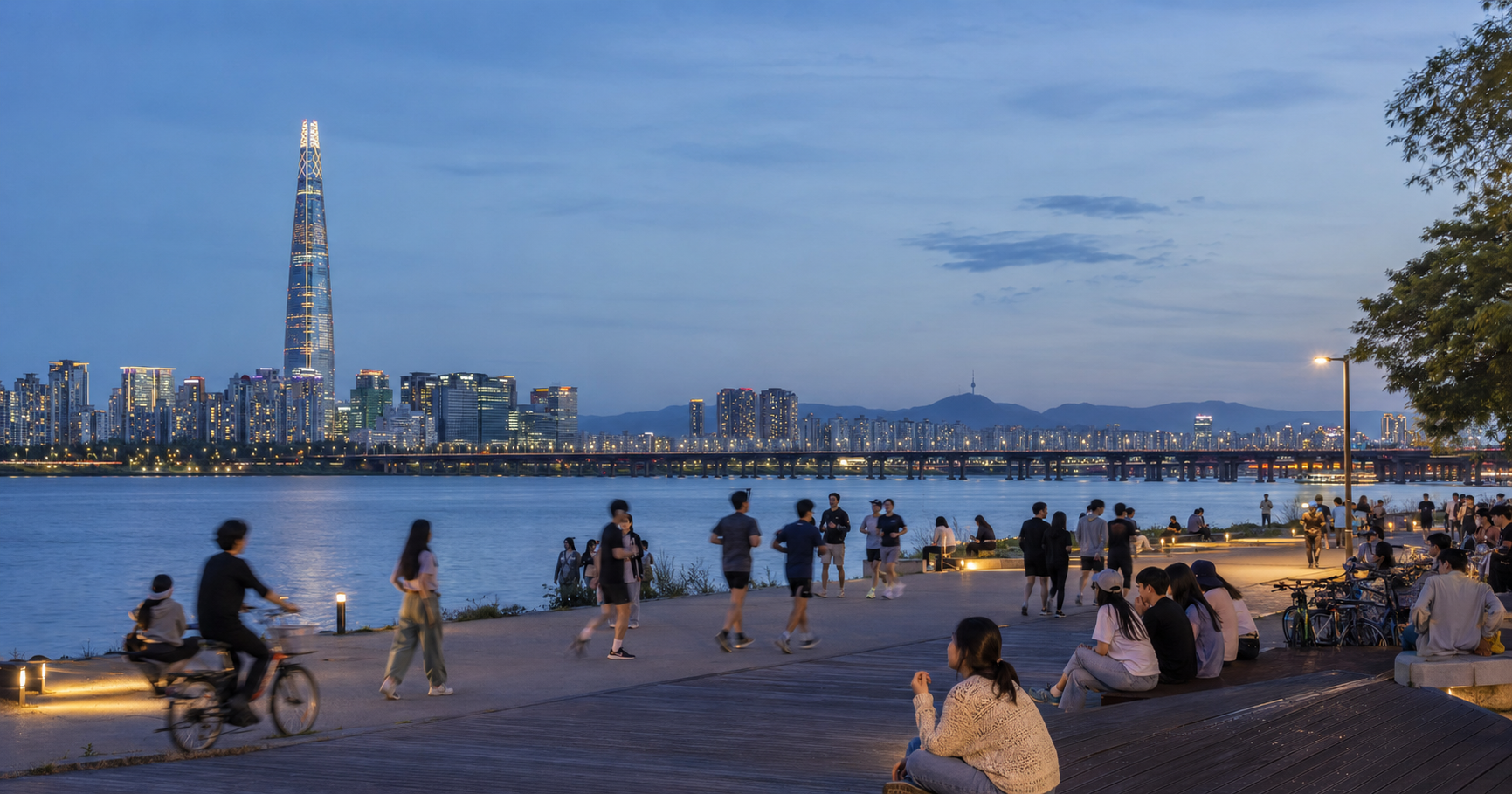
Yet in Seoul, commuters still crowd onto subway trains, cafés remain full, and families continue planning their weekends.
To an international visitor, this calm can seem difficult to understand. South Korea is not technically at peace with North Korea. The Korean War stopped in 1953 with an armistice, not a peace treaty. Seoul also lies relatively close to the Demilitarized Zone, usually called the DMZ.
So why do many South Koreans appear unconcerned about war?
The simple answer is that Koreans are not unaware of the danger. They have learned to live with it. Decades of repeated crises, strong military deterrence, confidence in the South Korea–United States alliance, and the demands of everyday life have turned an extraordinary security situation into part of the background.
South Korea Is an Armistice State, Not a Country at Peace
The Korean War began on June 25, 1950, when North Korean forces invaded South Korea. Fighting continued for more than three years and devastated much of the peninsula.
On July 27, 1953, military commanders signed the Korean Armistice Agreement. It stopped large-scale combat and established the Military Demarcation Line and the DMZ. However, the agreement was not a peace treaty.
This distinction matters. The armistice suspended hostilities, but it did not formally end the war or create normal diplomatic relations between the two Koreas.
The result is an unusual condition: South Korea is a modern democracy and major economy whose capital exists within reach of one of the world’s most heavily militarized borders.
Foreign visitors often learn this fact shortly before traveling to Korea. For South Koreans, however, it has been part of national life for more than seven decades.
The Threat Has Become Familiar
Many South Koreans have lived through repeated cycles of tension.
North Korea conducts a weapons test or makes a hostile statement. South Korea, the United States, and Japan respond. Military readiness increases, diplomats meet, and news coverage becomes intense. After days or weeks, the immediate anxiety usually fades without a full-scale conflict.
This pattern has occurred so many times that many people distinguish between threatening language and signs of an imminent attack.
That does not mean they believe North Korea is harmless. Public opinion in South Korea has become increasingly distrustful of the North Korean government, and debate over nuclear deterrence has grown. Still, distrust does not automatically produce daily panic.
Someone who has heard warnings since childhood may react differently from a visitor hearing them for the first time. Familiarity reduces the emotional impact, even when the underlying danger remains real.
Psychologists sometimes describe this as risk normalization. When a threat continues for years without becoming an immediate disaster, people incorporate it into their understanding of normal life.
Daily Life Demands More Immediate Attention
For most South Koreans, the problems that require action today feel more urgent than a war that might never happen.
People worry about housing costs, employment, business conditions, education, health, family responsibilities, and retirement. A parent preparing a child for an examination or a shop owner trying to pay the monthly rent cannot spend every day imagining a military conflict.
The same principle appears in many parts of the world. People living near earthquake zones, volcanoes, flood-prone rivers, or areas of political tension do not necessarily ignore danger. They simply cannot organize their entire lives around the worst possible event.
In Korea, this practical attitude is especially visible during periods of heightened tension. International headlines may sound alarming while restaurants remain busy and the stock market continues operating. Unless there are concrete signs of immediate escalation, daily routines usually continue.
Military Service Makes the Threat Concrete
Most able-bodied South Korean men are required to perform military service. As a result, military life is not a distant concept for many families.
Fathers, sons, brothers, friends, and colleagues have served in the armed forces. Many men have participated in field exercises, handled weapons, learned emergency procedures, and stood watch near sensitive areas.
This experience can have two effects.
First, it reminds people that the division of the peninsula is real. North Korea is not merely a political topic on television.
Second, it can create confidence that South Korea is not defenseless. The country maintains modern armed forces, conducts regular exercises, and has long prepared for possible conflict.
Military service does not make every Korean feel secure, and opinions about conscription vary. However, it helps explain why many people view national defense as an established system rather than an abstract promise.

Confidence in Deterrence Matters
South Korea’s calm also rests on deterrence: the belief that an attack would bring consequences so severe that North Korea has strong reasons not to begin a full-scale war.
South Korea has a powerful conventional military and a technologically advanced economy capable of supporting national defense. It is also protected by its mutual defense alliance with the United States.
The United States has repeatedly stated that its defense commitment to South Korea includes extended deterrence backed by the full range of American capabilities. The two countries conduct joint training and maintain formal consultation mechanisms concerning conventional and nuclear threats.
This does not eliminate risk. Miscalculation, a limited clash, or an accidental escalation is still possible. Deterrence is not a guarantee that nothing will happen.
Nevertheless, many South Koreans assume that North Korean leaders understand a major attack could threaten the survival of their own regime. That assumption is one reason dramatic statements from Pyongyang do not always produce dramatic reactions in Seoul.
Civil Defense Is Present but Easy to Overlook
Korea’s security situation also appears quietly in the physical landscape.
Emergency shelters exist in subway stations, underground parking areas, and public buildings. Civil defense exercises are held periodically. Warning systems can send emergency alerts directly to mobile phones. Residents near the border may encounter military checkpoints or restrictions that people in central Seoul rarely notice.
For most residents, however, these systems remain in the background. A subway station is first a place to catch a train, even if it can also serve as an emergency shelter.
The security system is therefore both visible and invisible. It is built into ordinary infrastructure without controlling every moment of daily life.
Younger Generations See North Korea Differently
Generational change also shapes public attitudes.
Older Koreans may have direct memories of the war or may have grown up listening to parents who experienced displacement, hunger, and the loss of family members. For them, division can be deeply personal.
Many younger South Koreans have no living memory of a unified peninsula. North Korea may feel less like a separated part of one nation and more like a hostile neighboring state with a different political system.
Recent surveys have shown declining enthusiasm for reunification, especially when people consider its potential economic and social costs. This does not mean younger Koreans support permanent hostility. It means the emotional idea of reunification may be weaker than it was for earlier generations.
Their concerns often focus more on preventing conflict and maintaining stability than on achieving national reunification as quickly as possible.
How the United States Views the Risk
The United States sees North Korea as both a direct military threat and a challenge to the regional and international security order.
North Korea’s long-range missile and nuclear programs mean the issue is not limited to defending Seoul. Washington must also consider the safety of American forces in the region, the defense of South Korea and Japan, nuclear proliferation, and the possibility of North Korean weapons technology spreading elsewhere.
American officials therefore tend to speak more openly about deterrence, readiness, sanctions, and denuclearization than ordinary Koreans do in daily conversation.
At the same time, the official American position is not simply that war is inevitable. The goal is to prevent war by making the costs of aggression clear while leaving room for diplomacy.
For many Americans watching from thousands of kilometers away, a missile launch can appear to be an isolated and alarming event. South Koreans often interpret the same launch within a much longer history of provocation, response, and restraint.
Japan’s Perspective Is Different Again
Japan is an important security partner of South Korea and the United States, but it is not South Korea’s bilateral treaty ally. That distinction is often lost in casual descriptions of the three countries.
Japan views North Korea’s missile program as an immediate national security threat. North Korean missiles have flown over or near Japanese territory, and Japan must consider possible attacks on its cities, military facilities, and surrounding waters.
The unresolved issue of Japanese citizens abducted by North Korea also gives the relationship a strong domestic and emotional dimension.
Official Japanese documents describe North Korea’s nuclear and missile development as a grave and imminent threat. Japan has therefore strengthened missile defense, expanded cooperation with the United States, and increased trilateral security coordination with South Korea.
From Tokyo’s perspective, stability on the Korean Peninsula is inseparable from Japan’s own security.
The United Kingdom and Other Western Countries
The United Kingdom views the Korean Peninsula from a greater geographic distance, but it is not disconnected from the conflict.
British forces fought under United Nations Command during the Korean War. The United Kingdom remains one of the countries associated with the continuing work of the UN Command and supports the enforcement of UN sanctions related to North Korea’s prohibited weapons programs.
British statements typically focus on several connected concerns: nuclear proliferation, violations of UN Security Council resolutions, regional stability, human rights, and the need for meaningful diplomacy.
Other Western governments generally share these concerns, although “the West” does not have a single uniform position. European countries may give greater attention to sanctions and non-proliferation, while countries with forces or strategic interests in the Indo-Pacific may emphasize military preparedness and regional alliances.
The distance also affects public perception. For someone in London, Paris, or Washington, North Korea may appear mainly during dramatic news events. For someone in Seoul, it is a permanent reality that rarely disappears but does not always dominate the day.
Calm Does Not Mean Indifference
It would be a mistake to conclude that South Koreans do not care about war.
Political arguments over military exercises, relations with North Korea, the American alliance, missile defense, and possible nuclear armament can become intense. People living close to the border may also experience provocations very differently from residents farther south.
When credible evidence of immediate danger appears, Koreans pay close attention. Financial markets react, military readiness increases, and families with soldiers become especially concerned.
The everyday calm seen in Seoul is therefore conditional. It reflects an assessment that full-scale war is unlikely today—not a belief that it is impossible.
What Visitors Should Understand
Visitors do not need to pretend that the security situation is meaningless. The Korean Peninsula remains divided, North Korea possesses nuclear weapons, and military incidents can occur.
However, travelers should also avoid treating every hostile statement as proof that war is about to begin. Official travel guidance, emergency alerts, and reliable news sources are more useful than sensational social media posts.
The most accurate view lies between panic and denial.
South Koreans live normally because they have built institutions, military defenses, alliances, emergency systems, and personal habits around a danger that has lasted for generations. Their calm is not necessarily ignorance. More often, it is a practical response to a threat that cannot be allowed to stop life indefinitely.
Conclusion
South Korea’s apparent lack of fear is one of the clearest examples of how people adapt to history.
The Korean War never received a final peace treaty, but South Korea could not remain emotionally frozen in 1953. It built cities, industries, democratic institutions, families, and ordinary routines while the division continued.
The United States views the peninsula through alliance commitments and extended deterrence. Japan sees North Korea as a direct missile and nuclear threat. The United Kingdom and other Western countries focus on regional stability, international law, sanctions, diplomacy, and non-proliferation.
South Koreans share many of those concerns. They simply experience them from inside a society that has been living beside the danger for more than seventy years.
The calm streets of Seoul do not prove that the threat has disappeared. They show that an unresolved war, however serious, has not been permitted to define every part of Korean life.
Official References
- United States–Republic of Korea Foreign and Defense Ministerial Joint Statement
- Japan’s Diplomatic Bluebook: The Korean Peninsula
- UK statement on North Korea at the United Nations
- Korea Institute for National Unification
- DMZ 비무장지대
Frequently Asked Questions
Is South Korea technically still at war with North Korea?
The 1953 Korean Armistice Agreement stopped large-scale fighting, but no peace treaty formally ended the Korean War. The two Koreas therefore remain in an unresolved military relationship.
Are South Koreans genuinely unconcerned about North Korea?
No. Many South Koreans distrust the North Korean government and take its nuclear and missile programs seriously. However, decades of recurring tension have made constant anxiety impractical.
Is Japan a military ally of South Korea?
Japan is not South Korea’s bilateral treaty ally. Both countries are separate treaty allies of the United States and increasingly cooperate through trilateral security arrangements.
Is it safe to travel to South Korea?
South Korea generally functions normally during periods of political tension. Visitors should follow official travel advice and emergency instructions because conditions can change.
Why does Seoul remain calm after North Korean missile tests?
Many residents see missile tests as serious but familiar acts within a repeated cycle of provocation and response. Unless there are clear signs of imminent conflict, schools, businesses, transportation, and public life continue normally.