
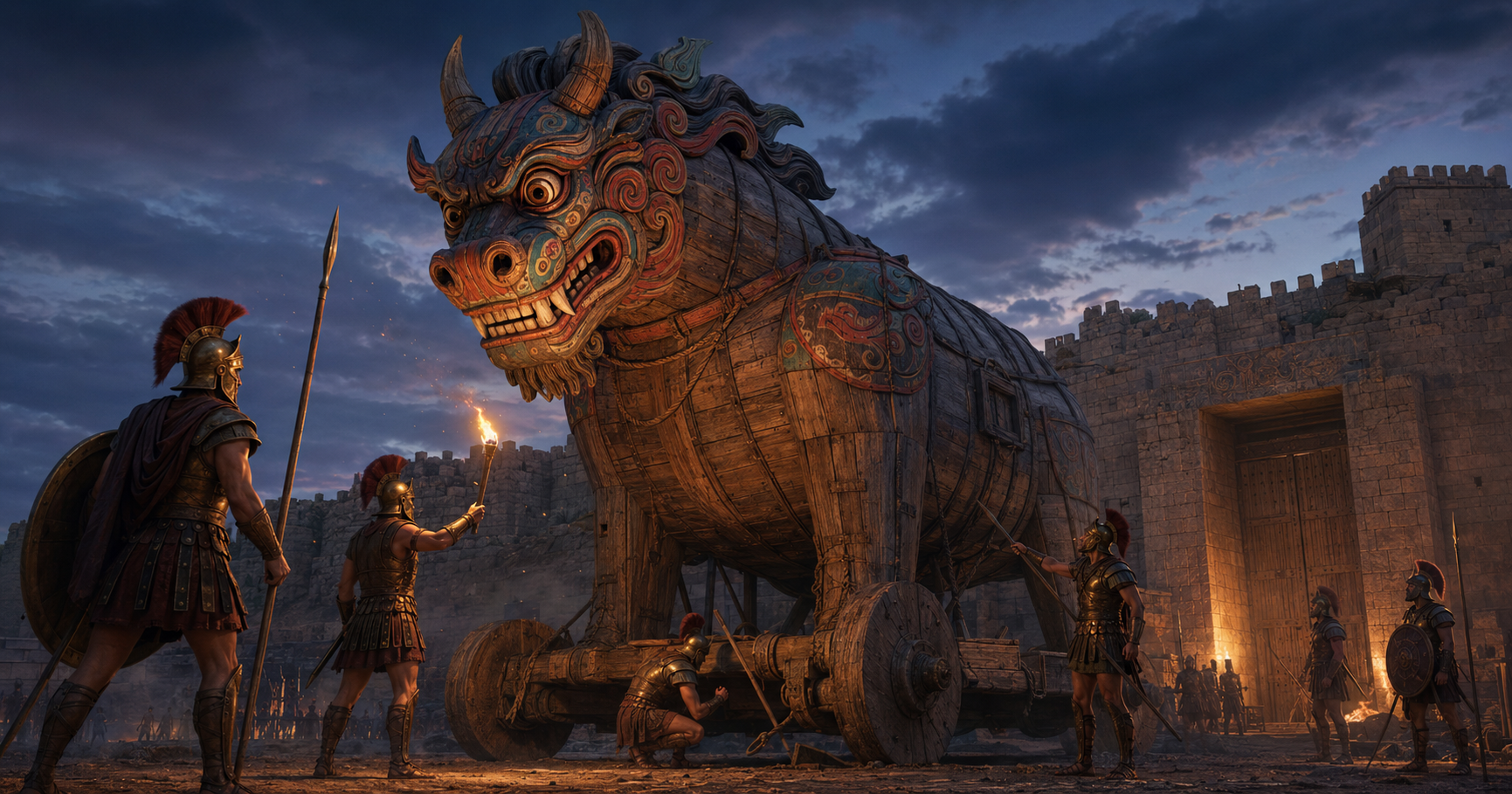

Have you ever wondered why, in an era of infinite streaming options, hyper-realistic video games, and CGI-heavy fantasy epics, we still can’t seem to get over a pair of poems written nearly three thousand years ago?
Homer’s The Iliad and The Odyssey are the ultimate survivors of literary history. They have outlived empires, survived the burning of libraries, and weathered countless cultural shifts. Today, they continue to inspire Hollywood blockbusters, bestselling novels, and deep intellectual debates.
But what is the secret to their eternal youth? Why does the Western world treat these ancient Greek texts as the holy grail of storytelling? And, perhaps most surprisingly, why is South Korea—a country thousands of miles away with its own rich history and folklore—currently experiencing a massive love affair with the gods and heroes of the Aegean Sea?
Grab a cup of coffee, and let’s dive into why Homer’s world remains the ultimate mirror for our own.
Part 1: The Western DNA — What Homer Means to the West
To understand why the West is obsessed with Homer, you have to understand that The Iliad and The Odyssey are not just “old books.” They are the genetic code of Western literature, psychology, and philosophy.
The Twin Poles of Human Experience: Kleos and Nostos
Homer masterfully captured the two most fundamental drives of the human condition in his twin epics:
- The Iliad (The Quest for Glory – Kleos): Set during the final weeks of the Trojan War, this is a story about the devastating price of anger, pride, and the search for immortal fame (kleos). It asks a brutal question: Is it better to live a long, peaceful, but forgotten life, or a short, violent, but glorious one?
- The Odyssey (The Journey Home – Nostos): This is the story of Odysseus trying to make it back to his wife and son after twenty years of war and wandering. It gave us the word “nostalgia” (literally, the pain of longing for home). It asks: How do we rebuild our humanity after experiencing unspeakable trauma?
For Westerners, these two concepts form the axis of life. We spend the first half of our lives fighting our own “Trojan Wars”—striving for career success, recognition, and legacy. Then, we spend the second half trying to find our way back to what truly matters: family, peace, and our true selves.
The Original Psychological Realism
Long before Shakespeare or modern novelists, Homer wrote characters who were deeply, beautifully flawed. Achilles is the greatest warrior on earth, but he is also a temperamental, grieving child who throws destructive tantrums. Odysseus is brilliantly clever, but his arrogance (hubris) repeatedly gets his entire crew killed.
Unlike the highly moralistic religious texts that followed, Homer’s epics did not demand perfection. They offered a secular scripture that allowed people to explore the messiness of human nature. The Greeks didn’t look to the gods for moral guidance—after all, Zeus was a serial cheater and Ares was a bully. Instead, they looked to the human heroes to understand how to live, suffer, and die with dignity.
Part 2: The Secret of Eternal Youth — Why Homer Outshines Modern Fantasy
We live in a golden age of fantasy. From The Lord of the Rings to Game of Thrones, writers have built incredibly complex worlds with intricate magic systems and sprawling lore. Yet, none of them have managed to make Homer obsolete. Why?
1. The Realism of Mortality
In modern high fantasy, magic is often a get-out-of-jail-free card. If a character dies, there is a resurrection spell. If an army is trapped, a dragon or a wizard can save them.
In Homer’s world, there is no magic that can conquer death. Even the gods are bound by Fate (Moira). When Achilles’ beloved friend Patroclus dies, he stays dead. When Odysseus’s men are eaten by the Cyclops, they are gone forever.
This absolute finality of death gives every choice a weight that modern fantasy often lacks. Because human life is fragile, brief, and constantly threatened by a chaotic universe, every act of courage, love, and loyalty becomes infinitely beautiful. The Greek gods actually envy humans because mortals have the privilege of dying, which makes our lives meaningful.
2. The Absolute Grey of Morality
Modern storytelling often falls into the trap of binary “good vs. evil” dynamics. But Homer doesn’t do heroes and villains.
In the Iliad, the Trojans are not demonized. Hector, the prince of Troy, is depicted as arguably the most honorable, loving father and husband in the entire epic. When Achilles kills him, it is not a moment of triumphant justice; it is a tragedy of cosmic proportions. The epic ends not with a victory parade, but with two grieving men—the Greek hero Achilles and the Trojan king Priam—weeping together over the bodies of their dead sons.
This psychological complexity is incredibly modern. It treats war not as an adventure, but as a tragic, soul-crushing tragedy that destroys both the victors and the vanquished.
Part 3: The Korean Connection — Why South Korea is Obsessed with Greek Myth
Now, let’s talk about a fascinating global phenomenon. If you visit South Korea today, you will find a deep, passionate engagement with Greek mythology that rivals, and sometimes exceeds, that of Western nations. From academic lecture halls to chart-topping K-pop albums, the ancient Greeks are everywhere in Korea.
Why does a country with its own rich Eastern heritage connect so deeply with these Western classics?
1. The Childhood “Manhwa” Phenomenon
For millions of Korean Millennials and Gen Z, their introduction to literature wasn’t through traditional folklore, but through a legendary comic book series. In the early 2000s, the multi-million-selling graphic novel series Greek and Roman Mythology (그리스 로마 신화) became a household staple.
It democratized the classics. Before they even entered middle school, Korean children knew the affairs of Zeus, the wisdom of Athena, and the trials of Odysseus as intimately as they knew their school schedules. This cartoon series built a massive, lifelong cultural foundation, making Greek mythology a familiar, comforting part of their intellectual landscape. Today, Jeju Island even hosts a massive, classical-style Greek Mythology Museum where families can interact with plaster replicas of ancient statues and explore a recreated Greek village.
2. Psychological Relief in a Competitive Society
South Korea is famous for its hyper-competitive academic and professional culture. From a young age, Koreans face immense societal pressure to succeed, perform, and conform to high moral standards.
This is where the humanism of Greek mythology provides a profound sense of psychological relief. In traditional Korean culture, Confucian values emphasize strict duty, respect for elders, and moral perfection. But Greek myths are delightfully, reassuringly messy.
In university courses on Greek classics—which are incredibly popular and draw hundreds of students—educators emphasize that the Greek heroes are never perfect. They make terrible mistakes, experience devastating failures, and get frustrated. Yet, they keep moving forward.
For young Koreans navigating a high-pressure society, the story of Odysseus trying to get home is deeply reassuring. It teaches them that experiencing setbacks, facing obstacles, and even making massive mistakes is not a sign of final defeat. It is simply a natural, essential part of the epic journey of life.
3. A Mirror of “Han” and “Heung”
Korean culture is often defined by two emotional concepts: Han (한), a collective feeling of unresolved grief, trauma, and longing born from a history of foreign invasions and national division; and Heung (흥), a resilient spirit of joy, energy, and community.
These emotional states map beautifully onto Homer’s epics:
- The raw, weeping grief of Achilles over Patroclus, or Penelope’s decades of quiet, agonizing waiting, resonates deeply with the melancholic beauty of Han.
- At the same time, Odysseus’s sharp-witted resilience, his capacity to celebrate life even in the face of monsters, and his ultimate triumph align perfectly with the survivalist energy of Heung.
4. The Pop Culture Reinterpretation
South Korea doesn’t just study the classics; it actively reinvents them for a global audience.
Take K-pop megastars BTS, for example. In their record-breaking albums and theatrical performances, they have deeply integrated Greek mythology. Their hit song “Dionysus” and their award-winning live performances feature complex imagery of Dionysian rituals and Greek symposia. For BTS, Dionysus—the god of theater, wine, and ecstasy—becomes a metaphor for the artistic struggle, the boundaries of fame, and the search for self-discovery.
Furthermore, modern mythological retellings like Madeline Miller’s The Song of Achilles have become massive commercial sensations in South Korea, ranking in the top tier of book sales on major Korean platforms. Younger Korean readers are captivated by how these retellings give voice to the marginalized, vulnerable characters in Homer’s brutal world, proving that the ancient texts can still speak directly to modern concerns of identity, empathy, and love.
Conclusion: We Are All Complicated Travelers
At the end of the day, Homer’s The Iliad and The Odyssey endure because they are not museum pieces. They are living, breathing maps of the human heart.
Whether you are a Western reader exploring the foundational roots of your cultural identity, or a Korean student finding comfort in the flawed resilience of Odysseus, the message of the epics remains universal.
We are all, in our own ways, “complicated” individuals. We are all fighting our own Trojan Wars, dealing with our own anger, and trying to navigate a chaotic, unpredictable ocean to find our way back to the people and places we love.
As long as humans continue to struggle, love, fail, and dream, Homer’s voice will continue to echo across the centuries—and across the oceans.
Deep Dive & Further Reading
If you are eager to dive deeper into the original texts, explore their rich historical contexts, and see how modern historians keep these ancient tales alive, I highly recommend checking out World History Encyclopedia. It is an incredible, highly accessible, and non-profit educational resource packed with beautifully detailed articles, interactive maps, and guides on Homeric epics and the ancient Greek world!