
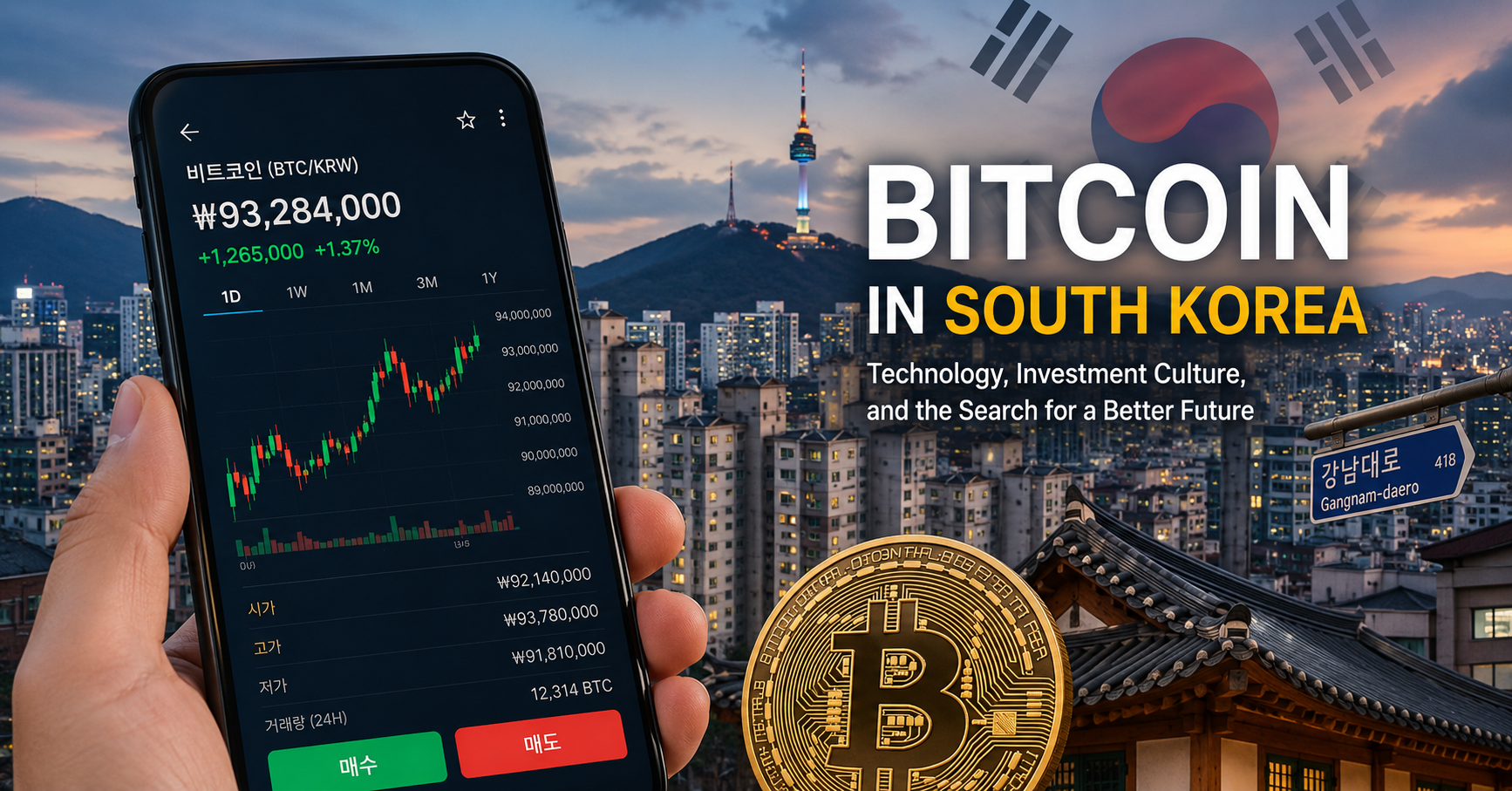

Walk into a café in Seoul during a sharp rise or fall in the cryptocurrency market, and you may overhear a familiar kind of conversation. Someone mentions Bitcoin’s latest price. Another person checks a trading app. A third quietly admits that they bought too late—or sold too early.
Bitcoin is not part of every Korean’s life, and many people have never purchased it. Yet public interest in cryptocurrency is unusually visible in South Korea. Market news appears in mainstream media, price movements spread quickly through online communities, and digital assets are often discussed alongside stocks, apartments, interest rates, and the cost of building a secure future.
This interest is sometimes explained as simple speculation. That is part of the story, but not the whole story. Korea’s enthusiasm for Bitcoin also reflects the country’s advanced digital infrastructure, strong investment culture, expensive housing market, generational anxiety, and rapid experience of economic change.
Bitcoin in South Korea Is More Than a Technology Story
Bitcoin was originally introduced as a decentralized digital currency that could be transferred without relying on a traditional central authority. In Korea, however, most ordinary participants have encountered it primarily as a tradable asset.
They usually do not mine Bitcoin, pay for groceries with it, or study blockchain code. Instead, they open an account with a domestic virtual asset exchange, deposit Korean won, and follow prices through a mobile app.
This makes the Korean Bitcoin experience feel closer to stock trading than to an alternative payment system. Chainalysis described South Korea in 2025 as the second-largest cryptocurrency market in the Asia-Pacific region by value received and noted that cryptocurrencies in Korea are traded in a liquid, speculative, and relatively mainstream manner.
That does not mean cryptocurrency has replaced traditional investing. Korean households still place enormous importance on property, bank savings, pensions, and stocks. Bitcoin has instead joined an already crowded field of assets that people watch while trying to protect or increase their wealth.
Korea Was Ready for Mobile Cryptocurrency Trading
One reason cryptocurrency spread quickly in Korea is simple: the country was already comfortable with digital life.
South Koreans adopted high-speed internet, online banking, mobile payments, digital games, and app-based services relatively early. By the time cryptocurrency exchanges became widely known, many people were already accustomed to moving money through a screen.
Opening an app to buy a digital asset therefore did not feel as strange as it might have in a society where banking remained dependent on paper forms, branch visits, and cash.
Korea’s dense urban environment also helped information travel quickly. Coworkers share news during lunch. Family group chats circulate investment stories. Online communities react to market movements within minutes. Video platforms, financial broadcasts, and messaging apps can turn a distant development in the United States into a topic of conversation in Seoul before the Korean trading day has fully begun.
This speed has advantages. People can learn about new technologies quickly. It also creates risks, because excitement, fear, and rumors move just as fast as reliable information.
The Investment Culture Behind Korea’s Bitcoin Interest
South Korea has a strong culture of personal investment.
For decades, property was considered one of the most reliable paths to household wealth. In more recent years, direct stock investing has also become common, particularly through mobile platforms. Financial expressions that once belonged mainly to professional investors are now used casually in everyday conversation.
Bitcoin entered this environment not as an isolated invention but as another possible path to financial advancement.
Many Korean investors actively compare opportunities across different markets. A person may hold Korean stocks, American stocks, exchange-traded funds, savings products, and cryptocurrency at the same time. The smartphone becomes a single window through which all of these assets can be monitored.
Cryptocurrency is especially attractive to active traders because it operates around the clock. The market does not close when Korean offices close. Prices can move late at night, on weekends, and during national holidays.
For some investors, this constant access feels empowering. For others, it can become exhausting. A market that never sleeps can easily encourage a person to check prices repeatedly, react emotionally, or trade without a clear plan.
Housing Costs and the Feeling of Falling Behind
To understand Korea’s fascination with Bitcoin, it is also necessary to understand the symbolic importance of housing.
Owning an apartment has long represented more than having a place to live. It can mean stability, marriage readiness, family security, educational opportunity, and protection against future inflation.
However, desirable housing in Seoul and other major urban areas is extremely expensive relative to the savings of many younger workers. A person with a regular salary may feel that careful saving alone will not allow them to catch up with rising asset prices.
This does not prove that every young Korean buys Bitcoin because of housing anxiety. People invest for many different reasons. Still, the gap between wages and major asset prices helps explain why high-return investments receive so much attention.
When conventional progress appears too slow, an asset that has previously risen dramatically can look like a rare shortcut. Stories about early Bitcoin buyers reinforce this impression. People remember the friend, colleague, or online investor who made a fortune. They hear less about those who lost money, left the market quietly, or spent years recovering from a poor decision.
The result is a powerful emotional combination: hope, urgency, regret, and fear of being left behind.
The Meaning of “One Big Chance”
Korean discussions about cryptocurrency often reveal a broader generational question: Is steady effort still enough?
Older Koreans experienced extraordinary national development. Within a few decades, the country moved from postwar poverty to industrialization, mass urbanization, and advanced technology. Many families saw the value of education, property, and businesses rise dramatically during their lifetimes.
Younger adults inherited a wealthier country, but they also entered a highly competitive society where housing, education, employment, and family formation can be expensive. They may have more comfort than earlier generations while feeling that upward mobility has become less predictable.
Bitcoin fits this tension perfectly.
It represents technological progress, independence from old institutions, and the possibility of exceptional returns. At the same time, it can behave like a highly volatile speculative asset capable of destroying savings quickly.
The attraction is therefore not merely greed. It can also express frustration with traditional routes to security.
The “Kimchi Premium” and Korea’s Intense Trading Periods
International cryptocurrency observers sometimes use the expression kimchi premium to describe periods when Bitcoin or other digital assets trade at higher prices on Korean exchanges than on overseas platforms.
The term refers to a market price difference, not to kimchi itself. It became widely discussed during periods of intense Korean demand, especially when capital controls, exchange rules, banking procedures, and limits on cross-border arbitrage made it difficult to eliminate the gap immediately.
The premium is not constant. It can shrink, disappear, or even reverse depending on market conditions.
Its importance is cultural as well as financial. The term became shorthand for the intensity of Korea’s retail cryptocurrency market. It also showed that Bitcoin did not always have one perfectly identical price everywhere once local regulations, currencies, and trading systems were taken into account.
Foreign readers should be careful not to interpret the kimchi premium as evidence that all Koreans are enthusiastic cryptocurrency investors. It describes a market condition, not an entire population.
A Market That Is Large but Not Always Predictable
Official Korean data shows both the scale of public participation and the changing nature of the market.
A Korea Financial Intelligence Unit survey covering the first half of 2025 found that the number of users eligible to trade rose by 1.07 million, or 11 percent, compared with the previous six months. At the same time, average daily trading volume, market capitalization, operating profits, and customer deposits all declined.
This combination is revealing.
More people may have access to the market even while trading activity and asset values fall. Registration does not necessarily mean constant trading, and public interest does not always move in the same direction as prices.
It also reminds us that cryptocurrency enthusiasm should not be measured by one dramatic headline. Korea’s market expands and contracts with global prices, regulations, investor confidence, and changing financial conditions.
Chainalysis also reported that nearly half of South Korea’s on-chain cryptocurrency activity came from transactions between $10,000 and $1 million, a category it described as professional-sized activity. This suggests that the market includes not only small experimental purchases but also substantial active trading.
Why Bitcoin and “Crypto” Are Not Always the Same Conversation
Korean media and everyday speech often use terms such as Bitcoin, coin, cryptocurrency, and virtual assets in overlapping ways.
They are not identical.
Bitcoin is one specific digital asset with its own network and fixed issuance rules. The broader cryptocurrency market includes thousands of other tokens with very different purposes, structures, liquidity levels, and risks.
Some Korean investors enter the market because they believe in Bitcoin as a long-term scarce asset. Others trade smaller tokens in search of short-term gains. Still others are more interested in stablecoins, blockchain businesses, or the future of digital payments.
This distinction matters because public discussions may begin with Bitcoin but quickly shift toward highly speculative altcoins. A reader who hears that “Koreans are interested in Bitcoin” should not assume that every investor follows the same strategy or understands the technology in the same way.
Stablecoins Are Becoming Part of the Korean Debate
Although Bitcoin remains the best-known cryptocurrency, Korea’s digital asset discussion is expanding.
Chainalysis estimated that Korean won purchases of stablecoins reached about $64 billion during the 12 months ending in June 2025. Stablecoins are digital tokens generally designed to maintain a value linked to an existing asset, commonly the U.S. dollar. Korean traders may use them for liquidity, hedging, or moving between different digital assets.
This growth has encouraged discussion about whether Korea should permit or develop won-denominated stablecoins.
The debate reaches far beyond speculative trading. Policymakers must consider banking stability, consumer protection, cross-border capital movement, monetary policy, payment systems, and the authority to issue money-like instruments.
The Bank of Korea has supported a cautious approach, emphasizing that any introduction of won-based stablecoins should consider possible effects on monetary policy and financial stability.
This shows how far the conversation has moved. Cryptocurrency in Korea is no longer only a subject for individual traders. It has become part of a national discussion about the future structure of finance.
Korea Has Strengthened Protection for Virtual Asset Users
South Korea has not responded to cryptocurrency with either complete acceptance or a total ban. Its approach has gradually moved toward regulated participation.
The Act on the Protection of Virtual Asset Users took effect on July 19, 2024. The framework requires virtual asset service providers to separate customer deposits from company funds, store at least 80 percent of customer virtual assets in cold wallets, maintain insurance or reserves for certain incidents, monitor abnormal transactions, and follow rules against unfair trading.
These protections are important, but regulation does not remove investment risk.
A properly registered exchange can still list assets that fall sharply in value. Bitcoin can still experience severe volatility. Users can still make emotional decisions, misunderstand a project, lose account credentials, or fall victim to impersonation and phishing.
Regulation may improve the market’s structure, but it cannot guarantee a profit or prevent every loss.
Korean authorities have continued to strengthen entry and compliance requirements for virtual asset businesses. A revision passed in January 2026 expanded screening powers concerning major shareholders and the organizational and financial capacity of service providers, with implementation expected in August 2026.
The Difference Between Public Interest and Public Approval
Cryptocurrency receives enormous attention in Korea, but attention should not be confused with approval.
Some Koreans view Bitcoin as digital gold or a hedge against the weaknesses of traditional finance. Some consider it a legitimate but risky investment. Others see the market as largely speculative and socially harmful.
Parents may worry about adult children placing savings into volatile tokens. Couples may disagree over investment losses. Office workers may hide trading activity from colleagues. People who made money during one market cycle may lose it during the next.
There is also a class dimension. A wealthy investor who loses a small percentage of a diversified portfolio is in a different position from a worker who borrows money or risks a housing deposit.
For that reason, the most accurate description is not “Koreans love Bitcoin.” It is that Bitcoin has become a highly visible object of hope, debate, experimentation, and anxiety in Korean society.
What Foreign Readers Often Misunderstand
One common misunderstanding is that Korea’s Bitcoin interest comes only from a love of gambling.
Speculation certainly exists, and some trading behavior resembles gambling. But reducing the entire phenomenon to national character creates a stereotype.
Korea’s market developed from a particular combination of circumstances:
- widespread high-speed internet and smartphone use
- familiarity with digital payments and online platforms
- active participation in stocks and property markets
- expensive housing and concern about wealth inequality
- strong social circulation of financial information
- a competitive culture that can intensify fear of falling behind
- confidence in technology mixed with distrust of slow economic mobility
Another misunderstanding is that cryptocurrency is commonly used as everyday money in Korea. In ordinary shops, restaurants, taxis, and apartment buildings, people generally use Korean won through cards, bank transfers, or mobile payment services. Bitcoin is far more visible as an investment than as a daily currency.
What Korea’s Bitcoin Interest Reveals
Bitcoin offers a useful window into modern Korea.
It reveals a society that adopts technology quickly but also worries about the consequences of rapid change. It shows the ambition of people who want financial independence and the anxiety of those who feel conventional opportunities are narrowing.
It also reflects a familiar Korean contrast. The country has highly regulated banks, sophisticated technology, and strong educational achievement, yet many individuals remain willing to enter an unpredictable market in search of a different future.
For some, Bitcoin is a serious long-term asset. For others, it is a short-lived trade. For policymakers, it is a market that must be supervised. For Korean society as a whole, it has become a mirror reflecting larger questions about wealth, fairness, technology, and hope.
That may be the most important reason Korea watches Bitcoin so closely. The conversation is not only about the price of a digital coin. It is also about whether the established paths to a stable life still feel achievable.
Official External Reference
For current Korean virtual asset regulations and official market survey releases, visit the English-language website of the Financial Services Commission of Korea.
This article is for cultural and educational purposes and does not constitute financial, legal, tax, or investment advice.
Frequently Asked Questions
Why is Bitcoin so popular in South Korea?
Korea combines advanced digital infrastructure, easy mobile trading, an active personal investment culture, expensive housing, and widespread concern about financial mobility. These conditions make high-growth assets such as Bitcoin especially visible, although not every Korean invests in cryptocurrency.
Do South Koreans use Bitcoin for everyday purchases?
Generally, no. Most everyday payments are made in Korean won through credit cards, bank transfers, and mobile payment services. Bitcoin is primarily treated as a tradable or investable digital asset.
What is the kimchi premium?
The kimchi premium refers to periods when cryptocurrencies trade at higher prices on Korean exchanges than on overseas exchanges. It can arise from strong local demand and barriers that prevent traders from quickly removing price differences.
Is cryptocurrency trading legal in South Korea?
Trading through properly registered service providers is permitted, but exchanges and users operate under anti-money-laundering, customer-verification, market-conduct, and user-protection rules. Regulations continue to evolve.
Does Korean regulation make Bitcoin investment safe?
No. Regulation can improve custody, transparency, and market supervision, but it cannot eliminate price volatility, fraud, poor investment decisions, or the possibility of losing money.