
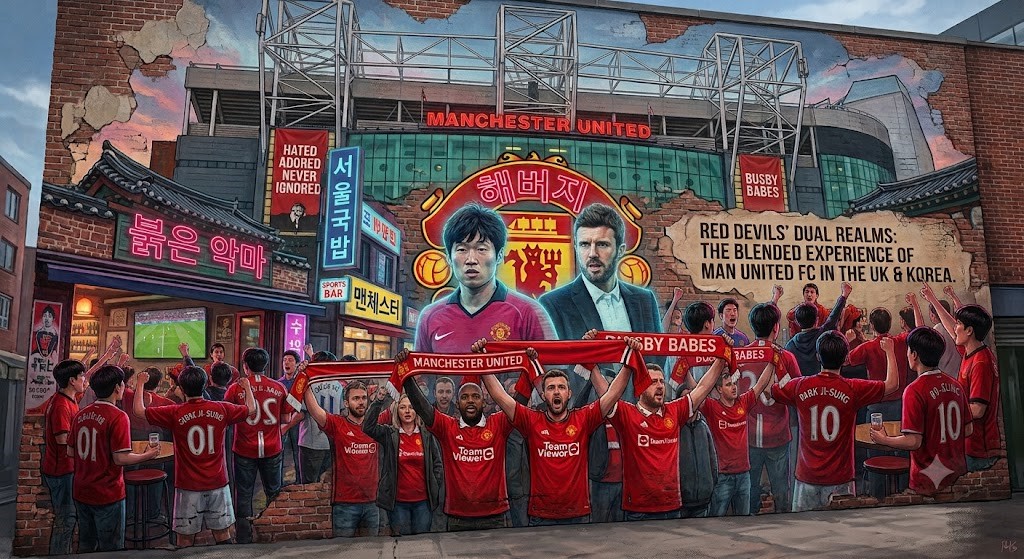

In the global theater of modern football, few institutions possess the cultural weight, economic scale, and polarizing gravity of Manchester United Football Club. Established in 1878 as Newton Heath LYR, the club has transformed from a local railway workers’ team into a multi-billion-dollar transnational enterprise that commands the loyalty—and the animosity—of hundreds of millions worldwide. At the physical and emotional center of this empire stands Old Trafford, famously christened the “Theatre of Dreams” by the legendary Sir Bobby Charlton. The stadium is globally recognized as a cathedral of sporting romanticism.
However, the sociological and cultural identity of Manchester United is far from uniform. Its perception undergoes a profound metamorphosis when viewed through different cultural lenses. In the United Kingdom, Manchester United is a deeply polarizing force, celebrated as a symbol of traditional working-class resilience while simultaneously loathed as an emblem of corporate excess, plastic fandom, and historical arrogance. Conversely, in South Korea, the club occupies a near-sacred status. This was primarily forged during the pioneering era of Park Ji-sung between 2005 and 2012, transforming Manchester United into a cultural bridge that connected a nation to the peak of Western European sport.
By analyzing these contrasting perspectives alongside the club’s dramatic competitive recovery in the recent 2025/26 season, this report explores how a single athletic brand can simultaneously embody a corporate titan at home and a romantic pioneer abroad.
The British Landscape: Hegemony, Hostility, and the “ABU” Phenomenon
Within its domestic borders, the cultural perception of Manchester United is defined by the polarizing maxim: “Hated, adored, never ignored”. This dual identity was forged during the relentless dominance of the club under Sir Alex Ferguson, whose tenure from 1986 to 2013 established a sporting hegemony that fundamentally altered the landscape of English football. This domestic supremacy drew intense hostility from rival fanbases, giving rise to a unique socio-cultural subculture known as “Anyone But United” (ABU). For millions of British football fans, their own club identity became secondary to their shared opposition to Manchester United’s dominance.
Table 1: Manchester United FC Perception in the UK
| Category | The Adored (Positive Perception) | The Hated (Negative Perception) |
| Core Element 1 | Resilience & Tragedy DNA • Deep emotional roots tied to overcoming the 1958 Munich Air Disaster. | ABU (Anyone But United) Phenomenon • Intense domestic hostility and rivalry built during decades of Ferguson’s dominance. |
| Core Element 2 | Youth Development • A strong cultural identity and pride centered around the club’s Academy focus. | Arrogance Stereotypes & Fandom • Perceptions of entitlement (“Do what we want” chants) and mocks of “Plastic” London fans. |
The domestic animosity toward Manchester United is rooted in several key sociological factors:
The Arrogance Narrative and Systemic Favoritism
United’s prolonged success fostered a perceived culture of arrogance. This was proudly adopted by Old Trafford match-goers through banners declaring “not arrogant, just better” and chants of “we’re Man United, we’ll do what we want”. Rival supporters viewed this as a symptom of systemic entitlement, believing that the club operated under a different set of rules. This resentment manifested in the widespread belief that Sir Alex Ferguson exercised undue influence over refereeing decisions and the Football Association, a narrative that persisted despite several high-profile disciplinary punishments handed down to United players.
The “Plastic” and “London Fan” Stereotype
A persistent critique of Manchester United’s domestic fanbase is the geographical disconnect of its supporters. Opposing fans frequently mock the club’s massive following in the South of England, particularly in London, as “glory-hunters”. This “London fan” caricature depicts United supporters as individuals with no authentic, generational connection to the city of Manchester. Instead, they are seen as choosing to align with a winning global brand, in contrast to the local working-class fanbases of rival regional clubs.
Club vs. Country Tensions
Manchester United supporters have historically maintained a detached, and sometimes hostile, relationship with the England national team. This “club over country” sentiment was forged through perceived injustices against United players by both the national press and England fans. The most infamous example occurred following the 1998 FIFA World Cup, when David Beckham was hung in effigy and subjected to a national hate campaign after being sent off against Argentina. Similarly, the perceived tactical misuse of Paul Scholes and the intense media scrutiny of Wayne Rooney deepened the siege mentality at Old Trafford. This led United fans to actively reject English national team fixtures, preferring to sing “you can stick your England up your arse” in support of their club’s players.
The Mythos of Munich and the Busby Babes: The Emotional Bedrock
To appreciate the emotional core that sustains Manchester United’s domestic support, one must look to the Munich Air Disaster of February 6, 1958. The crash of British European Airways Flight 609 claimed the lives of 23 people, including eight players from the legendary “Busby Babes” and three club officials. This tragic event derailed a generation of English football’s finest young talents and shattered the nucleus of a team poised to dominate European football.
The disaster did not merely evoke national sympathy; it fundamentally reshaped the identity of Manchester United. Under the temporary guidance of assistant manager Jimmy Murphy and the eventual return of a recovering Sir Matt Busby, the club underwent a decade-long resurrection. This culminated in the emotional triumph of winning the European Cup in 1968, featuring survivors Bobby Charlton and Bill Foulkes alongside a new generation of home-grown talents like George Best.
This narrative of tragedy, survival, and ultimate redemption created an emotional DNA that distinguishes Manchester United from modern, state-backed football clubs. It established a romantic mythos centered on youth development and attacking flair, ensuring that the club’s identity remains deeply rooted in resilience and heritage. Every year, thousands of fans still gather under the Munich clock at Old Trafford to pay their respects, proving that this historical trauma remains a vital pillar of the club’s contemporary culture.
The South Korean Perspective: “Haebeoji” and the Dawn of a Fandom
While Manchester United’s domestic identity is defined by local rivalries, historical tragedy, and class tensions, its perception in South Korea is built on a foundation of national pride and sports pioneering. The watershed moment occurred in the summer of 2005, when Sir Alex Ferguson signed a relatively unknown 24-year-old South Korean midfielder named Park Ji-sung from PSV Eindhoven.
Table 2: Park Ji-sung’s Double-Sided Legacy
| Perspective | Key Concept | Cultural & Tactical Role |
| U.K. Perception | Tactical Discipline | • Valued highly by domestic fans and management as a tireless “Defensive Winger.” • Recognized as a big-game specialist tasked with neutralizing elite opponents (e.g., Andrea Pirlo). |
| Korean Perception | “Haebeoji” | • Celebrated as the pioneering “Father of Overseas Football.” • Viewed as a central protagonist, national hero, and a cultural bridge for an entire generation. |
Park was the first South Korean player to sign for an English giant, and his transfer sparked a massive cultural phenomenon in his home country. Over the course of his seven seasons at Old Trafford, Park earned the nickname “Three Lungs Park” from the British media and teammates due to his extraordinary stamina and work rate. In South Korea, however, he was given a far more profound title: “Haebeoji” (해버지), a portmanteau of Hae-oe (overseas) and Abeoji (father). This title recognized Park as the patriarchal figure who popularized European football in Korea, paving the way for future generations of Asian athletes.
This fandom manifested in several unique cultural practices:
Nocturnal Collective Viewing and Cultural Shift
Because Premier League matches typically kicked off late at night or in the early hours of the morning in Korean Standard Time, millions of fans routinely adjusted their sleeping schedules to watch United matches. This midnight viewing culture transformed Manchester United into a de facto national team, where Park’s minutes on the pitch were analyzed with national significance.
The Evra-Park Relationship and Humanizing the Sport
The genuine off-field friendship between Park Ji-sung and French defender Patrice Evra became a sensation in South Korea. Their camaraderie, which persisted long after their playing careers, humanized the highly commercialized and cutthroat environment of elite European football, making the club feel accessible and warm to Korean supporters. The enduring appeal of this era was highlighted in April 2026, when the legendary duo reunited in Suwon, South Korea, to play in an exhibition match for the newly formed “OGFC” legends team alongside former teammates Wayne Rooney, Rio Ferdinand, and Ryan Giggs.
Divergent Perceptions of Play: Tactical Utility vs. National Hero
A fascinating cultural contrast exists regarding how Park’s playing style was valued. In the UK, Sir Alex Ferguson utilized Park as a highly disciplined tactical tool—often deploying him as a defensive winger to neutralize elite opposition playmakers like Andrea Pirlo. British fans valued him as the ultimate squad player. In Korea, however, Park was viewed as a central protagonist. Every goal he scored, such as his famous diving header against Liverpool, was celebrated as a historic triumph. While some modern critics debate his statistics relative to modern stars like Son Heung-min, his cultural legacy as the trailblazer of Asian football remains undisputed.
The 2025/26 Season: A Year of Turbulence, Transition, and Triumph
To appreciate Manchester United’s current standing, one must examine the extraordinary competitive turnaround of the 2025/26 season. The campaign began under the management of Ruben Amorim, but structural disagreements with the club’s hierarchy led to his dismissal on January 5, 2026. Following a brief interim spell under academy director Darren Fletcher, the board turned to a familiar face: former United midfielder and Middlesbrough coach Michael Carrick, who assumed head coaching duties on January 13, 2026.
Carrick’s return to Old Trafford was highly symbolic. As a player who spent 12 years at the club and was a close teammate and friend of Park Ji-sung during United’s golden era, his appointment was greeted with immense nostalgia in both the UK and South Korea. Tactically astute and deeply respected within the dressing room, Carrick inherited a squad sitting in 6th place and revitalized their campaign.
Under Carrick’s stewardship, United embarked on a phenomenal run of form, recording 11 wins, 3 draws, and just 2 losses in his 16 league matches in charge. His interim tenure began with consecutive victories over the league’s top two clubs, Manchester City and Arsenal, instantly restoring belief to the squad. This tactical resurgence propelled Manchester United to a 3rd-place finish in the Premier League, securing a return to the UEFA Champions League. On May 22, 2026, the club rewarded Carrick with a permanent contract running until 2028.
The final standings of the highly competitive 2025/26 Premier League season highlight the scale of Carrick’s achievement:
| Position | Club | Played | Won | Drawn | Lost | GF | GA | GD | Points |
|---|---|---|---|---|---|---|---|---|---|
| 1 | Arsenal (C) | 38 | 26 | 7 | 5 | 71 | 27 | +44 | 85 |
| 2 | Manchester City | 38 | 23 | 9 | 6 | 77 | 35 | +42 | 78 |
| 3 | Manchester United | 38 | 20 | 11 | 7 | 69 | 50 | +19 | 71 |
| 4 | Aston Villa | 38 | 19 | 8 | 11 | 56 | 49 | +7 | 65 |
| 5 | Liverpool | 38 | 17 | 9 | 12 | 63 | 53 | +10 | 60 |
| 6 | Bournemouth | 38 | 13 | 18 | 7 | 58 | 54 | +4 | 57 |
| 7 | Sunderland | 38 | 14 | 12 | 12 | 42 | 48 | -6 | 54 |
| 8 | Brighton | 38 | 14 | 11 | 13 | 52 | 46 | +6 | 53 |
| 9 | Brentford | 38 | 14 | 11 | 13 | 55 | 52 | +3 | 53 |
| 10 | Chelsea | 38 | 14 | 10 | 14 | 58 | 52 | +6 | 52 |
Player Performances and Transfer Impact in 2025/26
The success of the 2025/26 season was also driven by highly productive summer transfer business and the tactical maturation of key individuals under Carrick’s guidance. Chief among them was captain Bruno Fernandes, who thrived in a free-roaming attacking midfield role. Fernandes enjoyed a historic individual season, scoring 9 goals and providing a staggering 21 assists, which equaled the all-time Premier League single-season assist record. For his performances, Fernandes was awarded the prestigious Football Writers’ Association (FWA) Player of the Year award.
United’s attack was also bolstered by major summer arrivals:
- Benjamin Šeško: The Slovenian forward was signed from RB Leipzig for a substantial fee of €76.50m. He proved to be a clinical focal point, finishing the season as the club’s joint-top scorer with 11 league goals (12 in all competitions).
- Bryan Mbeumo: Signed from Brentford for €75m, the Cameroonian winger matched Šeško’s output, scoring 11 league goals (12 overall). His pace and direct running on the right wing completely transformed the team’s counter-attacking dynamics.
- Matheus Cunha: Arriving from Wolverhampton Wanderers for €74.20m, Cunha provided immense tactical versatility across the front line, contributing 10 goals and 4 assists.
- Patrick Dorgu: The young Danish left winger, signed from Lecce, proved to be an invaluable addition. Dorgu provided 4 assists and scored crucial, high-profile winning goals against Manchester City, Arsenal, and Brighton.
- Casemiro: The veteran midfielder experienced a prolific season, showing exceptional leadership and aerial presence to score 9 goals from defensive midfield.
The following table provides a structured breakdown of Manchester United’s key performers during the 2025/26 season:
| Player | Position | League Goals | Assists | Transfer Fee | Key Role in 2025/26 Season |
|---|---|---|---|---|---|
| Benjamin Šeško[cite: 26, 27] | Forward | 11 | 0 | €76.50m | Joint top goalscorer; clinical focal point in the penalty box. |
| Bryan Mbeumo[cite: 26, 27] | Forward | 11 | 3 | €75.00m | Joint top goalscorer; provided blistering pace and width. |
| Matheus Cunha[cite: 26, 27] | Forward | 10 | 4 | €74.20m | Versatile forward; key connector in transition play. |
| Bruno Fernandes[cite: 26] | Midfielder | 9 | 21 | Existing | FWA Player of the Year; equaled PL assist record. |
| Casemiro[cite: 26] | Midfielder | 9 | 1 | Existing | Defensive anchor; lethal aerial threat from set-pieces. |
| Patrick Dorgu[cite: 26, 27] | Defender | 4 | 4 | €35.00m | Versatile left-sided player; scored vital goals in big matches. |
Future Outlook: The INEOS Era and the New Old Trafford
Beyond the pitch, Manchester United is undergoing a profound structural and physical revolution under the sporting control of Sir Jim Ratcliffe and INEOS, who hold a 28.94% stake in the club. Ratcliffe’s tenure has been marked by a ruthless focus on modernization and corporate efficiency. While his aggressive cost-cutting measures—including the elimination of 450 jobs and the cancellation of long-held staff perks—drew sharp domestic criticism for eroding the club’s traditional community values, his sporting ambitions are undeniable.
The ultimate symbol of this new era was revealed on July 9, 2026. As part of the Trafford Wharfside Masterplan, Manchester United officially confirmed that they will construct a state-of-the-art, 100,000-seater stadium on land recently purchased just 350 meters from Old Trafford.
This massive project, dubbed the “Stadium District,” is designed to serve as a world-class hub for sport, entertainment, and urban regeneration. The masterplan is expected to generate 48,000 local jobs and 15,000 new homes, providing an estimated £7.3 billion annual boost to the UK economy. Crucially, club officials have emphasized that the new stadium will remain physically connected to the historic site, allowing supporters to preserve the heritage, traditions, and matchday rituals that have defined the “Theatre of Dreams” for over a century.
Conclusion: Two Worlds, One United
Manchester United remains a fascinating study in sports sociology. In the United Kingdom, it is a local institution shaped by decades of tribal rivalry, class identity, and a polarized domestic culture that oscillates between intense adoration and bitter resentment. In South Korea, it is a symbol of sports modernization and national pride, a club whose red shirt remains permanently associated with the heroic legacy of Park Ji-sung.
As the club transitions into a new era under the tactical guidance of Michael Carrick and the sweeping commercial ambitions of the INEOS regime, it continues to bridge these two worlds. Whether through the historic columns of the old Old Trafford or the grand architecture of the planned 100,000-seater arena, Manchester United remains a global cultural force that can never be ignored.
For further news on fixture details, ticket information, and the latest club announcements, please refer to the Manchester United Official Website.