

The intersection of classic literature, modern cinema, and folklore provides a rich landscape for analyzing how different cultures process universal human experiences. The release of Christopher Nolan’s cinematic epic The Odyssey (2026) has re-ignited global interest in humanity’s oldest storytelling traditions. By translating Homer’s foundational Greek epic into a visceral, three-hour IMAX spectacle, the film explores timeless themes of postwar trauma, the fragmentation of identity, and the grueling journey toward spiritual and physical return.
At the same time, this modern cinematic translation offers a unique opportunity for cross-cultural comparative analysis. By examining the narrative mechanisms of Nolan’s film alongside the rich tapestry of Korean Shamanism (Musok)—specifically the legendary, mischievous spirits known as Dokkaebi—one can discern how different cultures utilize supernatural archetypes to negotiate human vulnerability, morality, and the search for home.
The Production and Cast Profile of Christopher Nolan’s The Odyssey (2026)
To understand the scale of Nolan’s undertaking, it is necessary to examine the structural and technical dimensions of the film. Budgeted at $250 million, The Odyssey represents one of the most expensive and technologically ambitious projects in contemporary cinema, serving as the first feature film shot entirely on 70mm IMAX cameras.
| Production Dimension | Details and Key Data |
| Director & Screenplay | Christopher Nolan |
| Primary Source Material | Homer’s Odyssey (influenced by Emily Wilson’s 2017 translation) |
| Additional Sources | Virgil’s The Aeneid and Aeschylus’s Agamemnon[cite: 10] |
| Production Budget | $250 million |
| Cinematography | Hoyte van Hoytema (100% IMAX 70mm film) |
| Music Composer | Ludwig Göransson |
| Running Time | 172 minutes |
| Box Office Success | Surpassed Oppenheimer in presales; highest IMAX presales of all time |
The Cinematic Reinvention of Homer’s Epic in Christopher Nolan’s The Odyssey
Christopher Nolan’s adaptation of The Odyssey represents a departure from traditional “sword-and-sandals” Hollywood blockbusters, which historically prioritized melodramatic romance and sanitized heroism. Instead, the director reinterprets the Homeric legend as a gritty, psychologically complex study of postwar disillusionment. By integrating elements of Virgil’s Aeneid and Aeschylus’s Agamemnon, the screenplay reframes the Trojan War not as a romantic quest for Helen, but as a cold, commercial conflict over trade routes. This cynical backdrop establishes the emotional trajectory of Odysseus, portrayed by Matt Damon as a careworn, guilt-stricken military commander whose boyishness has been hollowed out by twenty years of violence and survival.
The Tragedy of Deception and the Expanded Role of Sinon
A pivotal narrative modification in Nolan’s adaptation is the elevated role of Sinon, portrayed by Elliot Page. While Sinon is absent from Homer’s original Odyssey—appearing instead in Virgil’s Latin epic The Aeneid—Nolan incorporates him to dramatize the heavy moral toll of Odysseus’s famed cunning (metis). In the film, Sinon is depicted as an honorable Ithacan soldier who takes the place of the aristocratic coward Antinous (Robert Pattinson) in the draft.
Sinon is ultimately sacrificed on the beaches of Troy as a crucial piece of Odysseus’s Trojan Horse deception. During the sequence in the Underworld, Odysseus is confronted by the mud-covered, vengeful spirit of Sinon. This encounter underscores the central theme of the film: the tragic consequences of strategic deception. Sinon’s accusation—that he died for a lie crafted by his own king—deepens Odysseus’s profound psychological trauma and introduces a modern critique of patriarchal and military arrogance.
Characterization and the Subversion of Archetypes
Nolan’s cast subverts the classical archetypes of the Homeric epic to ground the characters in recognizable human struggles:
- Odysseus (Matt Damon): Rather than an untouchable, semi-divine hero, Odysseus is presented as a deeply flawed strategist plagued by what modern psychology classifies as Post-Traumatic Stress Disorder (PTSD). His physical transformation—from a robust conqueror to a gaunt, weather-beaten wanderer—mirrors the erosion of his hubris.
- Penelope (Anne Hathaway): Penelope is stripped of the passive, domestic helplessness often attributed to her in older translations. She is depicted as a pragmatic, fierce ruler who has successfully managed the political power vacuum of Ithaca for two decades despite the continuous, predatory presence of suitors.
- Telemachus (Tom Holland): The prince of Ithaca is characterized by vulnerability and desperation, embarking on his own dangerous quest to locate his father, which serves as a coming-of-age journey parallel to Odysseus’s survival ordeal.
- Antinous (Robert Pattinson): The lead suitor is rendered as a sleazy, manipulative, and deeply cowardly aristocrat whose cruelty to the vulnerable emphasizes his role as the narrative’s primary domestic antagonist.
- Zendaya as Athena: Zendaya performs a dual role. She portrays the goddess of wisdom, warfare, and handicraft who guides Odysseus. In a striking narrative addition, she also portrays the young Trojan priestess of Athena killed during the sack of Troy, whose form the goddess later adopts to haunt and guide Odysseus, blending divine protection with psychological guilt.
- Samantha Morton as Circe: Morton delivers a scene-stealing performance as the sorceress of Aeaea. Her transformation of the Ithacan crew into pigs is framed not as malicious magic, but as an act of revealing their “true nature” of gluttony and greed.
- Charlize Theron as Calypso: Theron portrays the nymph of Ogygia as an angelically dressed, almost therapeutic captor who offers Odysseus a comfortable, immortal stagnation that threatens to erase his memory of home and mortality.
Narrative Comparison: Homer’s Original vs. Nolan’s Cinematic Adaptation
| Narrative Element | Homer’s Odyssey (Original Epic) | Christopher Nolan’s The Odyssey (2026 Film) |
| The Nature of the Trojan War | A heroic, legendary conflict triggered by the abduction of Helen. | A cold, cynical, commercial conflict fought over trading routes. |
| The Role of Sinon | Minor character mentioned in relation to the fall of Troy; not in the Odyssey text. | A major, tragic Ithacan soldier who represents the human cost of Odysseus’s deception. |
| The Character of Antinous | An arrogant, greedy suitor vying for the Ithacan throne. | A cowardly aristocrat who bribes Sinon to take his place in the war. |
| The Climax and Ending | Odysseus kills the suitors, reunites with Penelope, and re-establishes his reign. | Odysseus abdicates the throne to Telemachus and departs Ithaca with Penelope for a quiet life. |
The Linguistic Shift and the Emily Wilson Influence
A key conceptual pillar of Nolan’s adaptation is its deliberate reliance on the 2017 translation of The Odyssey by classicist Emily Wilson. Wilson’s translation made history as the first English rendering of the epic poem by a woman, winning acclaim for its plain, direct, and rhythmic iambic pentameter. Nolan was specifically captivated by Wilson’s opening line, which defines Odysseus not as “the man of twists and turns” (as in Robert Fagles’ translation) or “the man for wisdom’s various arts renowned” (Alexander Pope), but simply as “a complicated man”.
This philosophical shift toward immediate, unpretentious language directly shaped the film’s screenplay and dialogue choices. In Nolan’s film, characters use contemporary, accessible English—including colloquialisms such as “Mom,” “Dad,” and “party”—which drew sharp criticism from traditionalists on social media who accused the film of cheapening the epic register.
However, cultural analysts and classicists, including Mary Beard, have defended this linguistic choice. The use of modern domestic vocabulary does not diminish the work; rather, it highlights the intimate, familial core of The Odyssey. By stripping away the neoclassical, “museum-bound” pomposity of 18th-century translations, Nolan and Wilson restore the original oral tradition’s primary function: to deliver an immediate, emotionally gripping tale of domestic disruption, survival, and moral ambiguity to a contemporary audience.
Introducing the Dokkaebi of Korean Shamanism
While Western audiences are familiar with the monsters of Greek antiquity, Korean folklore offers a different category of supernatural beings that navigate the boundaries of the human world: the Dokkaebi. In traditional Korean Shamanism (Musok) and folk narratives, Dokkaebi are unique nature spirits or minor deities possessing extraordinary, unpredictable magical powers.
Origins and Materiality
Unlike gwisin (departed human souls or ghosts), a Dokkaebi is not born from death. Instead, it is created through the spiritual possession of old, discarded household tools—such as worn-out brooms, mortars, pestles, or hearth pokers—especially those stained with human blood or sweat.
This material origin ties the Dokkaebi directly to the domestic sphere of human labor. Because they emerge from objects that have shared the daily struggles of common people, they possess a deeply empathetic, “human-like” quality, reflecting the desires, hardships, and anxieties of the communities that created them.
Characteristics, Traits, and Talismans
Traditionally depicted in oral culture as tall, imposing, hairy, and robust figures (resembling ogres or giants rather than the small, green goblins of Western lore), Dokkaebi are renowned for their playful and emotional temperaments. They possess an insatiable love for buckwheat jelly (muk), rice cakes, and rice wine (makgeolli). They are also characterized by their obsession with ssireum (traditional Korean wrestling), frequently challenging travelers to matches on misty mountain passes.
To navigate the human world, Dokkaebi utilize two primary magical talismans:
- Dokkaebi Bangmangi (Magic Club): A wooden or iron club used to summon treasures, food, or gold. Crucially, the club does not create wealth out of nothing; it teleports existing resources, effectively functioning as a tool of wealth redistribution from the greedy to the impoverished.
- Dokkaebi Gamtu (Invisibility Hat): A traditional bamboo woven hat that grants complete invisibility to its wearer, allowing either the spirit or a clever human to move unseen through the physical world.
Regional Variations: The Jeju Island Yeonggam and the Durin-gut
In the unique shamanistic traditions of Jeju Island, the Dokkaebi is worshipped and appeased as Yeonggam. According to the Yeonggam Bon-puri (the shamanic narrative of the goblin’s origin), the Yeonggam are seven brothers born in Seoul and exiled to Mt. Halla. The youngest of these brothers is described as a hideous, mischievous, and highly lustful creature. This youngest brother frequently becomes infatuated with human women, possessing them and driving them into a state of severe mental derangement (durin).
To cure this madness, Jeju shamans (mudang) perform the Durin-gut (deranged ritual) or Yeonggam-nori. In this exorcism, the shaman does not violently attack the spirit; instead, they prepare a feast of the Yeonggam’s favorite foods (buckwheat jelly, fish, and rice wine) and politely petition the older, more benevolent Yeonggam brothers to come and take their troublesome, lustful sibling back to the spirit realm. This psychological possession and subsequent ritual cleansing mirror the thematic structure of The Odyssey.
Cross-Cultural Parallels: Connecting the Odyssey and Dokkaebi Lore
Despite originating from entirely different geographical, historical, and spiritual landscapes, the narrative structures of Homer’s Odyssey (and Nolan’s adaptation) share profound structural and symbolic commonalities with the folklore of the Korean Dokkaebi. Both mythological systems use interactions with supernatural entities to test, punish, or reward human behavior, establishing a clear moral order in a chaotic universe.
Comparative Mythological Framework: Greek Epic vs. Korean Shamanism
| Narrative Domain / Character Type | Greek Epic / Nolan’s Adaptation | Korean Shamanic Counterpart (Dokkaebi) | Shared Symbolic Function & Narrative Mechanism |
| The Trickster / Clever Hero | Odysseus (metis, cunning, survival strategy) | Clever Mortals outsmarting the Dokkaebi | Valorization of intellect, psychological manipulation, and strategic wit over raw, brute physical force. |
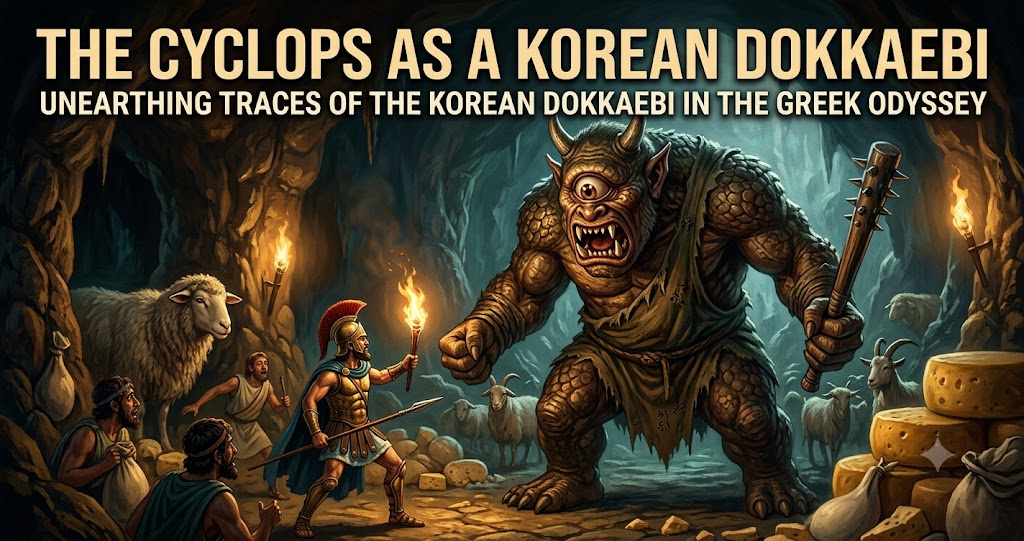
| The Wild, Chaotic Giant | Polyphemus (The Cyclops) | Cham-Dokkaebi (The Wild Mountain Spirit) | Representation of the uncivilized, untamed margins of nature; powerful yet intellectually vulnerable to human cunning. |
| The Moral Arbiter & Tester | Circe (Aeaea) / Calypso (Ogygia) | Karmic Dokkaebi (Rewarding/Punishing spirits) | Supernatural entities that evaluate human greed, pride, and integrity, altering material reality to match inner morality. |
| Spiritual Possession & Madness | The Sirens / Calypso (Identity erosion) | Yeonggam (Jeju Island Shamanic Dokkaebi) | Erotic temptation and supernatural possession that causes madness (durin), requiring ritual restoration of the self. |
The Wit of the Trickster: Metis vs. Outsmarting the Spirit
In The Odyssey, Odysseus’s defining characteristic is his metis—a term denoting cunning, resourcefulness, and practical intelligence. He survives not through the martial prowess of Achilles, but through verbal deception, disguise, and strategic planning. In Nolan’s film, this is highlighted by his utilization of Sinon’s fake desertion to smuggle the Trojan Horse into Troy, and his clever escape from the cave of the Cyclops Polyphemus by claiming his name is “Nobody”.
This dynamic closely mirrors the core narrative of Korean Dokkaebi folktales, which frequently celebrate the triumph of human intelligence over supernatural strength. In these legends, Dokkaebi are physically immense and possess terrifying strength, but they are also intellectually naive, gullible, and easily tricked.
For example, when a Dokkaebi challenges a traveler to a ssireum match, the traveler cannot win through raw power; instead, they must exploit the Dokkaebi’s anatomical weakness (such as tripping its single leg or attacking its right side).
In another famous tale, an old man tricks a Dokkaebi by exploiting its fear of blood (while claiming his own fear is money), resulting in the angry spirit showering his house with bags of gold to “punish” him. Both mythological traditions emphasize that when mortals are confronted by overwhelming, capricious forces, survival depends entirely on intellectual flexibility and strategic cunning.
The Wild Margin: Polyphemus and the Liminality of the Dokkaebi
In Homeric Greek thought, the Cyclopes represent the absolute antithesis of polis (civilized city-state life). Polyphemus lives in a chaotic, isolated cave, does not till the soil, lacks laws, and disregards the sacred rules of hospitality (xenia). In Nolan’s film, the horror of the Cyclops’ cave is rendered with visceral dirt, blood, and animalistic chaos, conveying the terror of the untamed wilderness.
Dokkaebi occupy a remarkably similar liminal space in the Korean cultural landscape. Traditionally, Dokkaebi do not dwell in structured villages; they materialize in dark, humid, eerie, and transitional spaces—such as misty mountain passes, old abandoned mills, outer village boundaries, or rocky shorelines.
Like the Cyclops, the Dokkaebi represents the raw, chaotic, and uncontrollable forces of nature. However, while the Greek Cyclops is purely predatory and must be violently blinded to be escaped, the Korean Dokkaebi is more ambiguous. It represents a nature that can be negotiated with, befriended, or channeled to bring fertile harvests and bountiful fishing catches, provided that humans maintain ecological and moral respect.
Moral Metamorphosis and Karmic Reversal
In Christopher Nolan’s The Odyssey, the encounters with the sorceress Circe and the nymph Calypso are framed as profound tests of human identity and moral integrity. Samantha Morton’s Circe famously transforms Odysseus’s greedy, gluttonous sailors into pigs, asserting that she is merely revealing their “true nature”. The physical metamorphosis of the sailors serves as an externalization of their spiritual degradation.
This moral feedback loop is the defining function of the Dokkaebi in Korean Shamanistic thought. Dokkaebi are essentially instruments of karmic justice. In folk literature, they closely observe human behavior:
- The Diligent and Kind: Are rewarded with wealth, fertility, and the wish-granting bangmangi.
- The Arrogant and Covetous: Are tricked, humiliated, and punished.
For instance, if a greedy man attempts to steal a Dokkaebi’s gold, the spirit’s magic will transform the treasure into useless charcoal or horse dung.
Both the Greek epic and Korean folklore use supernatural intervention to demonstrate that human moral choices have physical consequences, and that the cosmos will inevitably correct imbalances of pride and greed.
Erotic Temptation, Loss of Identity, and the Jeju Yeonggam
One of the most compelling comparative links exists between the seductive, disorienting forces in The Odyssey (the Sirens, Circe, and Calypso) and the specific Dokkaebi lore of Jeju Island, known as the Yeonggam.
In Nolan’s film, Calypso (Charlize Theron) represents a comfortable, immortal stagnation—a beautiful purgatory that threatens to erase Odysseus’s memory of his home and his mortality. The Sirens, similarly, use their voices to induce a state of madness and self-destruction, pulling sailors away from their life journeys.
In the Jeju Yeonggam tradition, the youngest brother’s infatuation with human women causes severe mental derangement (durin). This state of madness and loss of agency mirrors the spiritual erosion Odysseus faces under the influence of the Sirens or Calypso. Both the Jeju Durin-gut and Odysseus’s struggle represent the profound human fear of losing one’s mind, memory, and agency to supernatural, chaotic desires. Both narratives offer a path back to sanity and home through structured, communal rituals of remembrance and alignment with the higher cosmic order.
Conclusion: The Universal Human Journey
Christopher Nolan’s The Odyssey (2026) demonstrates that the ancient Greek struggle for home remains deeply resonant in our contemporary, fractured world. By stripping away historical romance and emphasizing the heavy psychological toll of war and deception, the film presents Odysseus not as an untouchable icon, but as a traumatized survivor fighting to reclaim his humanity.
When placed in a comparative framework with the Dokkaebi and Yeonggam of Korean Shamanism, this narrative reveals a striking cross-cultural consensus. Whether navigating the storm-tossed Mediterranean under the wrath of Poseidon, or wandering the misty slopes of Mt. Halla haunted by a mischievous spirit, human beings have always utilized the supernatural to process trauma, evaluate morality, and make sense of their vulnerabilities.
Ultimately, both The Odyssey and the legends of the Dokkaebi remind us of the same fundamental truth: the longest, most dangerous journey we will ever undertake is not across physical landscapes, but through the internal wilderness of our own souls to find our way back home 1 .
the Odyssey review-theguardian