
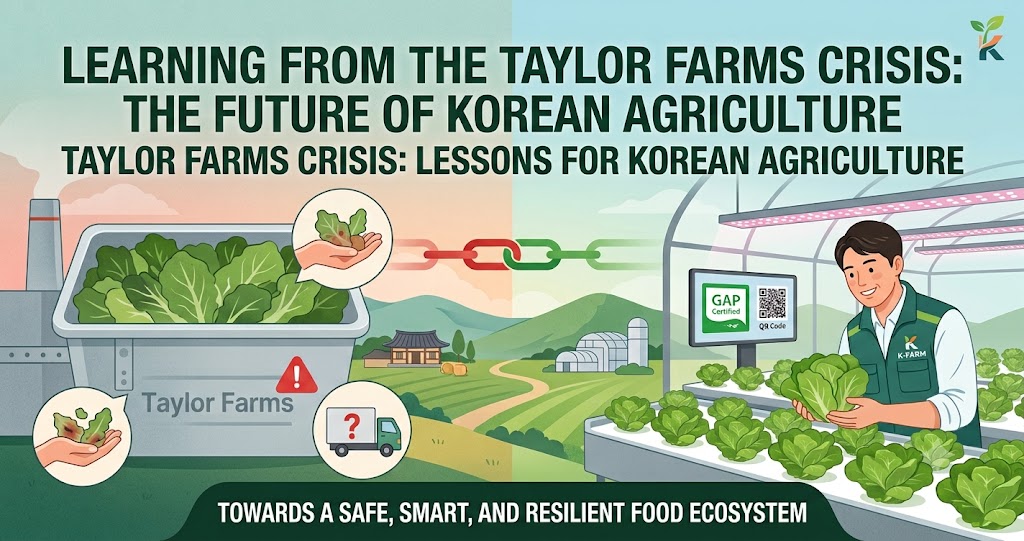

Update — July 24, 2026: CDC and FDA reported at least 1,947 Cyclospora illnesses across nine states, including 98 hospitalizations and no deaths. Taylor Farms initiated a recall on July 17 covering iceberg lettuce sourced from central Mexico. The investigation remains open, and official figures may continue to change.
From Soil to Shelf: What the Taylor Farms Crisis Teaches Us About the Future of Korean Agriculture
What the Taylor Farms Crisis Means for Korean Food Safety
When you walk into a modern supermarket in Seoul, Tokyo, or New York, the produce aisle feels like a triumph of human engineering. There is a soothing, clinical perfection to it all. Romaine lettuce is pre-washed, shredded, and sealed in airtight plastic. Onions are neatly diced and portioned, ready to be tossed into a pan or sprinkled over a burger. Earthy dirt, irregular shapes, and the seasonal rhythm of harvest have been quietly engineered out of the consumer experience. We have traded the rustic chaos of the traditional market for the absolute convenience of “ready-to-eat” convenience foods.
But in the summer of 2026, this illusion of clinical safety was shattered once again.
A major food safety crisis sent shockwaves through the global food supply chain, centering on one of the agricultural industry’s ultimate giants: Taylor Farms. The California-based producer—responsible for supplying salads, sliced vegetables, and fresh greens to retail giants and fast-food chains worldwide—found its products linked to a sweeping, multi-state outbreak of illness.
For consumers in the West, it was a terrifying reminder of how vulnerable our centralized food systems really are. But for those of us watching from South Korea, the “Taylor Farms Crisis” is more than just a distant international news headline. It is a cautionary tale, a mirror, and an urgent wake-up call for the future of Korean agriculture.
Korea’s agricultural sector is currently standing at a historical crossroads. On one hand, the domestic market is rapidly shifting toward the same Western-style convenience food models: pre-washed salads, meal kits (mil-kit), and ready-to-eat (RTE) fresh produce are exploding in popularity. On the other hand, Korea’s physical farming landscape remains deeply traditional, characterized by small-scale, highly fragmented family farms.
How can a country bridge this gap while learning from the food-safety challenges associated with large-scale industrial agriculture? What can Korea’s unique regulatory frameworks teach the rest of the world? And how can Korean farmers, policymakers, and consumers safeguard the food on our dinner tables?
In this article, we examine the Taylor Farms outbreak, the food-safety challenges associated with large-scale produce supply chains, and the lessons South Korea can apply to build a safer and more resilient food system.
Part 1: Anatomy of a Crisis—What Happened at Taylor Farms?
To understand how a problem involving a single agricultural supplier can become a multi-state public health concern, we must first examine the scale and structure of modern food processing.
The Titans of Fresh-Cut Produce
Taylor Farms is a major North American producer of fresh-cut vegetables and prepared foods. Its products are distributed through grocery stores, food-service companies, and restaurant supply chains. This scale helps make fresh produce widely available, but broad distribution can also allow a contamination incident to affect consumers across multiple locations.
Large fresh-produce operations bring together crops from multiple farms for washing, cutting, packing, and distribution. Centralized processing can improve consistency and traceability, but it also requires rigorous sanitation, testing, and monitoring to prevent cross-contamination.
This hyper-efficiency is a marvel of capitalist logistics. It keeps prices incredibly low and ensures that fresh lettuce is available in the middle of a freezing winter. But this level of centralization also creates a massive, singular point of failure.
The Outbreaks of 2024 and 2026
The vulnerabilities of this system became glaringly obvious in a series of highly publicized health crises:
- The 2024 E. coli Onion Outbreak: In late 2024, an outbreak of E. coli O157:H7 was linked through epidemiological and traceback evidence to fresh, slivered onions served on McDonald’s Quarter Pounder hamburgers. Taylor Farms recalled yellow onions supplied to McDonald’s and other food-service customers. CDC reported 104 illnesses across 14 states, including 34 hospitalizations, four cases of hemolytic uremic syndrome (HUS), and one death. FDA testing did not find the outbreak strain in the recalled onions or environmental samples, but the epidemiological and traceback evidence identified the onions as the likely source.
- The 2026 Cyclospora Outbreak: In July 2026, CDC and FDA investigators linked a multistate outbreak of Cyclospora infections to iceberg lettuce sourced from central Mexico and recalled by Taylor Farms de Mexico. As of July 24, the outbreak included at least 1,947 confirmed illnesses across nine states, 98 hospitalizations, and no reported deaths. Epidemiological and traceback evidence pointed to iceberg lettuce served at Taco Bell locations, although the investigation remained open and the figures were subject to change.
The Illusion of “Pre-Washed” Safety
The most terrifying aspect of these outbreaks is that they involved ready-to-eat (RTE) products.
When a consumer buys raw, unwashed potatoes or carrots, they expect to wash, peel, and cook them. Heat from cooking acts as a natural “kill step,” destroying harmful pathogens like Salmonella, E. coli, and Cyclospora.
However, pre-washed salad kits are consumed raw. The consumer trusts that the “triple-washed” label on the bag guarantees safety.
In reality, if a pathogen enters an industrial washing line, the water itself can act as a vector for cross-contamination.
If contaminated lettuce enters a shared washing system, pathogens may spread through the water and cross-contaminate other pieces of produce. Furthermore, slicing or shredding vegetables damages plant tissue and releases moisture and nutrients that can support bacterial growth if temperature and sanitation controls are inadequate.
When contamination occurs in a large processing facility, widely distributed products can expose consumers across multiple regions before the problem is detected.
Part 2: The Changing Landscape of Korean Food Consumption
Now, let us turn our eyes to South Korea. For generations, the Korean kitchen was built on a foundation of raw, whole ingredients. Preparing dinner meant sitting on the floor, peeling garlic, washing mud-caked radishes, and carefully trimming wild greens.
But Korean society has undergone one of the fastest demographic and cultural transformations in human history.
The Rise of the Solo Consumer and “Convenience-First” Eating
Korea is currently grappling with a dramatic demographic shift: the rise of 1-person households (일인 가구). Single-person homes now make up over 35% of all households in the country. At the same time, work hours remain long, and the desire for convenience has reached an all-time high.
For a young professional living in a officetel in Mapo or Gangnam, buying a whole head of cabbage, a bundle of green onions, and a sack of carrots makes zero sense. Much of it would rot in the fridge before it could be eaten.
Instead, Korean consumers have embraced:
- Pre-Washed Salads (간편 채소): Neatly packaged salad bowls sold at convenience stores like GS25 and CU, or ordered via early-morning delivery services like Kurly (formerly Market Kurly) and Coupang Rocket Fresh.
- Meal Kits (밀키트): Pre-portioned, pre-sliced ingredients for complex dishes like Doenjang Jjigae, Mille-Feuille Nabe, or Gambas al Ajillo, which can be cooked in under ten minutes.
- Ready-to-Eat (RTE) Fruits: Peeled and sliced apples, single-serving cups of grapes, and pre-cut watermelon spears.
| Category | Traditional Consumption Model | Modern Convenience Model |
| Produce Form | Raw, soil-covered whole vegetables | Pre-washed, shredded, and packaged |
| Preparation | Home-washing, peeling, and trimming | Ready-to-eat (No prep required) |
| Consumption | Primarily cooked (stews, stir-fries) | Primarily raw (salads, snacks) |
| Efficiency | Higher waste for single-person households | Maximized convenience |
| Safety Reliance | Low (heat from cooking acts as a kill step) | High (dependent on industrial washing) |
This shift is incredibly convenient. But it means that South Korea has rapidly adopted the exact same consumer habits that made the Taylor Farms crisis so devastating in the West. We are eating more raw, industrially processed, fresh-cut agricultural products than ever before.
But do we have the infrastructure to keep them safe?
Part 3: The Unique Vulnerabilities of South Korea’s Agricultural System
While Korea’s consumption patterns are matching Western trends, the way Korea produces its food is fundamentally different. This mismatch creates a unique set of challenges.
1. Small-Scale, Fragmented Farms vs. Mass Consolidation
In the United States, agricultural land is measured in thousands of acres. Farming is dominated by multi-million-dollar corporations utilizing GPS-guided tractors and massive, automated irrigation networks.
In contrast, Korean agriculture is defined by fragmentation. The average Korean farm size is tiny—typically hovering around 1.5 hectares (approx. 3.7 acres) per household. Many of these farms are managed by elderly farmers who have been practicing traditional cultivation techniques for decades.
| Attribute | United States (e.g., Taylor Farms Model) | South Korea (Domestic Farming Model) |
| Average Farm Size | Very Large (100s to 1,000s of hectares) | Extremely Small (Avg. ~1.5 hectares) |
| Ownership | Corporate / Large-scale commercial | Family-owned / Elderly smallholders |
| Traceability | High tech but highly centralized | Historically difficult, improving |
| Processing | Mass centralized washing/slicing plants | Direct-to-market or local cooperatives |
When you have a highly fragmented supply chain, ensuring absolute uniformity in hygiene and agricultural practices is incredibly difficult.
- If a major retail platform like Coupang wants to source lettuce for its fresh salad line, it cannot buy from just one massive farm. It has to aggregate produce from dozens of small, independent farms scattered across regions like Gangwon-do or Chungcheong-do.
- If one of those small farms uses contaminated water or fails to manage livestock runoff near their fields, those contaminated leaves are mixed into the central distribution pool. Tracking down the exact source of contamination after the fact becomes an administrative nightmare.
2. The Microbe and Parasite Blindspot
Historically, Korean food safety regulations and public awareness have been heavily focused on chemical contamination. Ask any average Korean shopper what they worry about when buying vegetables, and they will immediately answer: “잔류농약” (pesticide residues).
Because of this deeply ingrained fear, Korea has built world-class systems to monitor chemical usage. However, biological pathogens—specifically bacteria like E. coli and Salmonella, viruses like Norovirus, and parasites like Cyclospora—have historically taken a backseat in the public consciousness.
Many people still harbor the dangerous belief that “if it’s grown in clean Korean soil, it’s naturally safe.” But pathogens do not care about national borders. As we transition to a culture that consumes raw, cold vegetables instead of thoroughly boiled stews (jjigae) and stir-fries (bokkeum), our biological safety standards must undergo a massive paradigm shift.
Part 4: South Korea’s Shield—The Pillars of National Food Safety
Fortunately, South Korea is not defenseless. Over the past decade, the Korean government, spearheaded by the Ministry of Agriculture, Food and Rural Affairs (MAFRA) and the Ministry of Food and Drug Safety (MFDS), has constructed some of the most rigorous food safety frameworks in the world.
Let’s break down the three primary defensive shields that protect Korean consumers from agricultural crises.
1. The Positive List System (PLS)
If you want to understand how strict Korean agricultural standards are, look no further than the Positive List System (PLS).
Introduced fully in January 2019, PLS is a revolutionary regulatory framework for pesticide residues.
Before PLS, if a farmer used a pesticide that didn’t have a specific safety limit set for a particular crop, regulators would apply a default, lenient standard. Under PLS, this loophole was completely slammed shut.
The PLS Rule: If a pesticide is not explicitly registered and approved for use on a specific crop, its allowable limit is automatically set to a flat 0.01 mg/kg (ppm).
To put that into perspective, 0.01 mg/kg is essentially zero—it is the absolute limit of modern laboratory detection. If even a trace amount of an unregistered chemical is found on a crop, the entire harvest is immediately banned from distribution, and the farmer faces severe financial and legal penalties.
While PLS was initially met with immense anxiety by older farmers who were used to sharing pesticides across different crops, it has successfully cleaned up Korea’s domestic chemical footprint. It has forced Korean agriculture to become incredibly disciplined and precise.
2. Good Agricultural Practices (GAP) Certification
While PLS handles chemical safety, the GAP (Good Agricultural Practices) certification program is designed to tackle the exact biological risks that plagued Taylor Farms.
Introduced to the Korean market in 2006, the GAP system is a holistic, “farm-to-table” management protocol. It regulates every single stage of agricultural production to prevent contamination.
The post-harvest component is especially important because it establishes hygiene and handling controls during sorting, washing, and packing—stages at which fresh produce can otherwise be exposed to contamination.
3. Smart Agricultural Traceability
South Korea is a global technology powerhouse, and it has actively leveraged this expertise to secure its food chain.
Through the Agricultural Traceability System (농산물이력추적관리제도), consumers can scan QR codes on packaged produce to instantly view the entire history of the product:
- Which farm grew the crop, including the farmer’s name and location.
- When the crop was harvested and processed.
- The results of pesticide and safety inspections.
If an outbreak occurs, traceability records can help authorities identify affected products more quickly, support targeted recalls, and reduce unnecessary disruption across the wider supply chain.
Part 5: Masterclass for Korean Agriculture—Lessons from the Taylor Farms Crisis
Having examined the challenges of large-scale food supply chains and the strengths of South Korea’s agricultural system, we can now identify practical priorities for the future of Korean agriculture.
How does South Korea prevent a “Korean Taylor Farms Crisis”? We must focus on five critical pillars.
1. Decentralization with “Smart” Clusters
The core flaw of the Taylor Farms model is the extreme concentration of processing. When one facility fails, a whole continent gets sick.
Korea should actively avoid building massive, mega-centralized processing facilities. Instead, the country must champion “Smart Agricultural Clusters”—a network of regional, highly automated processing centers managed by local agricultural cooperatives (Nonghyup).
- Regional Isolation: If a biological outbreak occurs in a facility in Gangwon Province, the damage is naturally contained to that region. The rest of the country’s food supply remains completely unaffected.
- Localized Traceability: Smaller supply chains make it infinitely easier to trace a bad batch of greens back to the specific greenhouse or field where they were grown.
2. Upgrading Safety Metrics: Pathogen-First Testing
It is time to expand our defensive perimeter. Korea’s agricultural testing protocols must shift from being primarily chemical-focused to being aggressively biosecurity-focused.
We need to implement routine, rapid DNA-based testing (such as PCR testing) at all major packaging and processing facilities to actively screen for:
- Escherichia coli (E. coli)
- Salmonella species
- Norovirus (the primary culprit behind winter food poisoning in Korea)
- Cyclospora cayetanensis (the parasite driving the 2026 U.S. outbreaks)
By catching these biological pathogens at the processing facility before the products are packaged and loaded onto delivery trucks, we can stop outbreaks in their tracks.
3. Climate Change Adaptation in Farming
It is impossible to talk about modern food safety without addressing the elephant in the room: climate change.
⚠️ Climate Change & Pathogen Transmission Pathways
| Step | Process | Action |
| Torrential Monsoons | Soil Analysis | ──▶Flooding & Runoff (Livestock manure) |
| Flooding & Runoff | Pathogen Testing | ──▶Pathogens Transfer (To low-lying crops) |
| Pathogens Transfer | Sanitary Packaging | ──▶RTE Salad Bowls (Pathogen growth) |
South Korea’s climate is rapidly transitioning from temperate to subtropical. We are seeing hotter, more humid summers, prolonged monsoons (장마), and sudden, torrential downpours.
This humid, wet environment is the absolute ultimate breeding ground for bacteria and mold. Heavy rain can cause soil and animal manure runoff from nearby livestock facilities to flood into vegetable fields, contaminating low-growing crops like lettuce, strawberries, and green onions.
Korean agriculture must adapt by:
- Moving high-risk crops from open-air fields into highly controlled smart greenhouses and vertical indoor farms.
- Enforcing strict physical buffer zones between livestock farms and open agricultural fields to prevent runoff contamination during heavy rain events.
4. Overhauling the “Ready-to-Eat” Cold Chain
Bacteria multiply exponentially when temperatures rise. In food safety, there is a crucial concept known as the Cold Chain—maintaining a continuous, unbroken temperature-controlled environment from the moment a crop is harvested until it enters the consumer’s home.
Korea’s early-morning delivery services are incredibly efficient, but the “last-mile” delivery remains a major vulnerability. Leaving fresh, pre-washed salad unrefrigerated on a hot and humid doorstep for several hours can increase food-safety risks by interrupting the cold chain.
We must establish:
- Strict regulatory definitions for what constitutes a “Ready-to-Eat” agricultural product, complete with mandatory cold-storage indicators on packaging (e.g., smart temperature-sensitive inks that change color if the product exceeds 4°C).
- Enhanced guidelines for delivery services to ensure that fresh-cut produce is always packed in high-quality insulated containers with sufficient cooling elements.
5. Cultivating Global Trust for Korean Exports
Korean agricultural products—often grouped under the “K-Food” banner—are enjoying unprecedented global popularity. From premium strawberries in Singapore and pears in the United States to processed cultural foods like Kimchi and Gochujang, exports are hitting historic highs.
To sustain this momentum and transform Korean agriculture into a highly trusted global brand, safety must be our primary export.
By showing the world that Korean agricultural exports are backed by the strict safety guarantees of PLS, GAP, and state-of-the-art cold-chain logistics, Korea can command a massive premium in international markets. Safety is not just a regulatory chore; it is a powerful economic engine.
Conclusion: The Road to a Safer, Smarter Table
The 2026 outbreak illustrates how a widely distributed fresh-produce supply chain can amplify the consequences of a contamination event. It does not by itself prove that scale or centralization caused the outbreak, but it highlights the importance of traceability, sanitation, testing, and rapid recalls.
As South Korea rapidly marches toward a highly modernized, convenience-focused food culture, we cannot afford to walk blindly down that same dangerous path.
We have a golden opportunity to build something better. By blending Korea’s advanced technological prowess with our strict regulatory frameworks like PLS and GAP, we can pioneer a Third Way for agriculture:
A system that matches the absolute convenience of modern life with the uncompromising safety and regional resilience of localized, smart farming.
At the end of the day, food is the ultimate bridge between human health and the earth. Protecting that connection is the most sacred duty of farmers, policymakers, and consumers alike. By learning from the mistakes of the past and aggressively investing in a smarter, safer agricultural future, South Korea can ensure that our tables remain safe, abundant, and deeply trusted for generations to come.
What are your thoughts on this?
Do you regularly buy pre-washed salads or meal kits? Did the Taylor Farms food safety crisis change how you view “convenience” food? Let’s start a conversation in the comments below!
Key Resources & Official Links
- U.S. Food and Drug Administration (FDA) – The primary U.S. federal agency responsible for overseeing food safety, agricultural inspections, and managing outbreaks related to fresh produce.
- Centers for Disease Control and Prevention (CDC) – Official investigation updates and public health guidance for the 2026 Cyclospora outbreak linked to iceberg lettuce.
- Ministry of Agriculture, Food and Rural Affairs (MAFRA) – South Korea’s central government body managing agricultural frameworks and smart farming initiatives.
- Ministry of Food and Drug Safety (MFDS) – The South Korean regulatory authority counterpart to the FDA, overseeing national standards for food and produce safety.