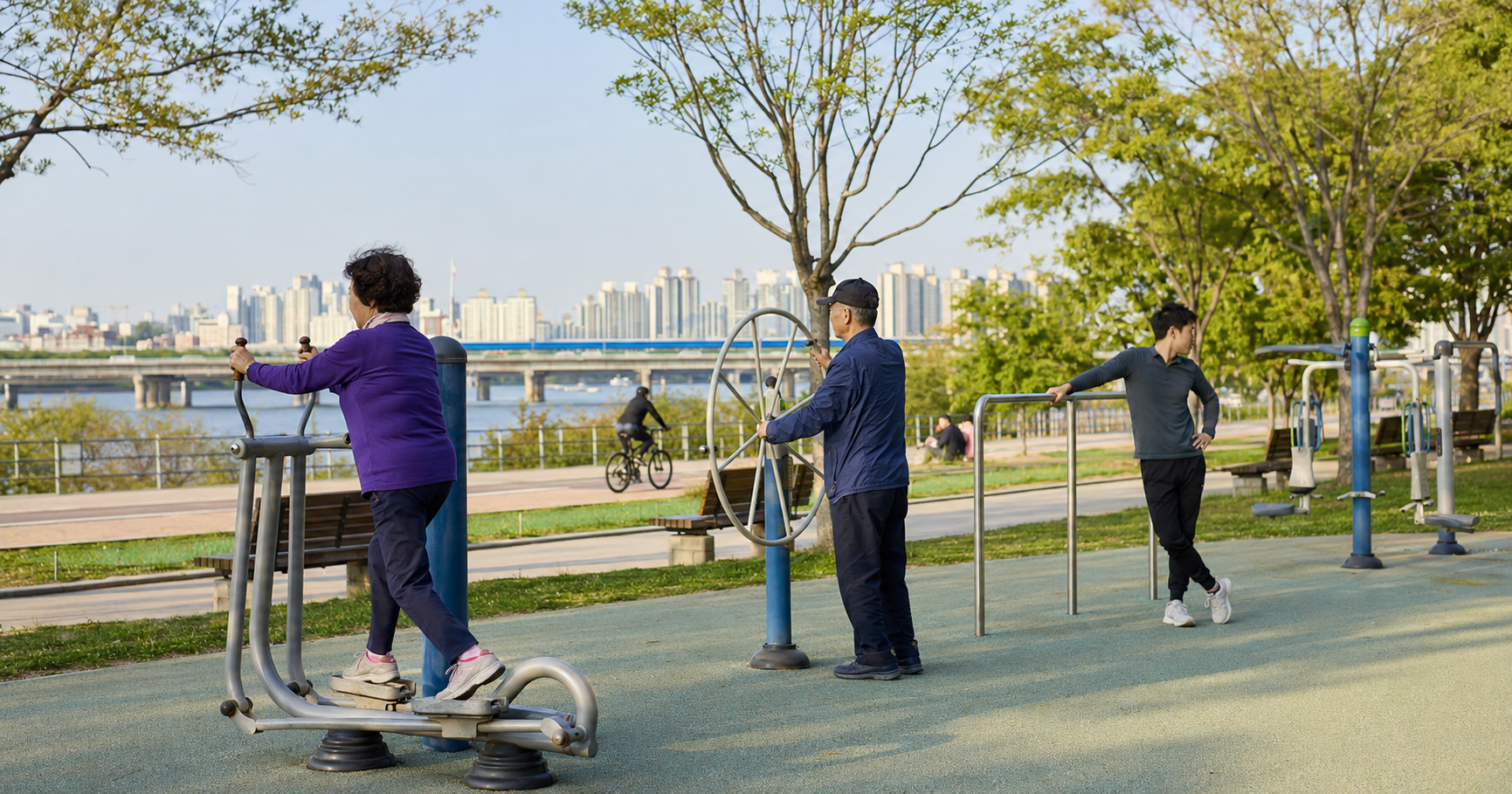

Walk through a neighborhood park in South Korea early in the morning, and you may encounter a scene that rarely appears in travel guides. A few older residents are rotating large shoulder wheels. Someone is moving rhythmically on an air walker. Nearby, a man pauses during his walk to stretch his back against a roller.
After more than fifty years of living in Korea, I still notice how naturally these outdoor fitness stations fit into morning walks, riverside exercise, and everyday neighborhood routines.
These machines are not part of a private fitness club. They are public exercise equipment, and in most locations, anyone can use them free of charge.
Outdoor fitness stations are common in Korean parks, beside streams, along mountain trails, and near apartment neighborhoods. They are not found in every park, and the number and condition of the machines vary. Still, they are widespread enough to feel like an ordinary part of Korea’s urban landscape.
For international visitors, these small outdoor gyms offer more than a place to exercise. They reveal how walking, recreation, public health, and neighborhood life often share the same space in Korea.
What Are Korea’s Outdoor Park Gyms?
Korea’s outdoor park gyms are clusters of weather-resistant exercise machines installed in public recreation areas. Most are intended for stretching, mobility work, balance, or light strength training rather than intense bodybuilding.
They are commonly placed near walking paths so that people can add a few exercises before, during, or after a walk. In most ordinary parks, there is no entrance fee, membership, changing room, or staff member.
You simply approach an available machine and use it.
These exercise stations can appear in:
- neighborhood parks;
- riverside and streamside parks;
- apartment complex green spaces;
- mountain and forest parks;
- public walking trails;
- local sports grounds;
- rest areas near hiking routes.
Official tourism information for places such as Samcheong Park and Seoul’s Naksan Park specifically lists exercise equipment among the available facilities. Similar examples can be found outside Seoul as well, although individual parks differ considerably.
A visitor should therefore think of outdoor exercise equipment as a common feature of Korean public space, not a guaranteed facility in every park.
Why Are They So Common in South Korea?
The equipment makes sense when viewed alongside three familiar parts of Korean life: dense urban neighborhoods, a strong walking and hiking culture, and a rapidly aging population.
Many Korean residents live in apartments with easy access to a neighborhood park, stream, low mountain, or landscaped walking path. Because homes, paths, and public facilities are often close together, a person does not need to make a separate trip to exercise.
A short walk can naturally become a light workout.
Korea’s mountain culture also matters. Hiking is a popular recreational activity, especially among middle-aged and older adults. Public exercise stations placed near trail entrances or along gentle mountain paths extend that culture of everyday movement.
At the same time, outdoor equipment gives residents who may not want—or be able—to join a commercial gym a convenient option close to home. An older person can walk, stretch, meet neighbors, and return home without crossing the city or paying a monthly fee.
The machines do not replace professional fitness facilities, medical rehabilitation, or properly designed strength training. Their main value is simpler: they lower the barrier to moving the body.
What Kind of Equipment Will You Find?
The selection varies by location and by the age of the facility. A large riverside park may have an extensive fitness area, while a small neighborhood park may offer only three or four machines.
Common examples include:
- air walkers or gliders;
- leg presses;
- waist-twisting discs;
- shoulder rotation wheels;
- pull-up and parallel bars;
- sit-up benches;
- stretching rails;
- back or leg rollers;
- step machines;
- seated upper-body machines.
Many machines use the user’s body weight or provide a fixed, relatively light level of resistance. This makes them approachable, but it does not make every machine suitable for every person.
The large shoulder wheels are especially recognizable. Users hold the handles and slowly rotate the wheels to move their shoulders through a broad range of motion. Another familiar device has ribbed rollers that people press against their backs, thighs, or calves.
These rollers may resemble a public version of a foam roller, but they should be used gently. Applying too much pressure or moving aggressively can be uncomfortable and may aggravate an existing injury.
Some parks also have heavy hula hoops stored near an exercise area. These are separate from the permanently installed machines and are not available everywhere. The large hoops can be more difficult to control than ordinary lightweight versions, so first-time users should be cautious.
How Koreans Actually Use the Machines
The equipment is rarely treated as a destination requiring special preparation. Instead, it becomes part of an existing routine.
A resident might walk around a park for half an hour and stop at two machines on the way home. A cyclist may pause beside a riverside path to stretch. Parents watching children at a nearby playground might use an air walker for a few minutes.
Early morning is often the most active time. Older residents arrive before the streets become busy, move from one machine to another, and talk with familiar neighbors. The atmosphere can feel as social as it is athletic.
In the evening, the users may include office workers, couples taking a walk after dinner, runners cooling down, and families enjoying cooler air after a hot summer day.
Not everyone follows a formal program. Some people use one favorite machine every day, while others try several in no particular order. This relaxed approach is part of the appeal, although visitors should not assume that another person’s technique is necessarily the correct one.
A Small Community Space
Outdoor exercise areas also function as informal meeting places.
In a private gym, people may arrive wearing headphones, complete a planned workout, and leave. In a neighborhood park, exercise is more visible and conversational. Residents recognize one another, exchange greetings, discuss the weather, or rest together on a nearby bench.
This is especially meaningful for some older adults. A daily visit provides movement, fresh air, and regular contact with other people.
The social atmosphere does not mean visitors are expected to start conversations. It is perfectly acceptable to exercise quietly. If a machine is occupied, wait nearby without standing too close. When several people are waiting, avoid using one station for an unnecessarily long time.
These are not strict written rules. They are simply the shared manners of a public space.
What Does “Sansjang” Mean?
You may occasionally see Korean internet users call a mountain exercise area a sansjang (산스장).
This is an informal nickname created by combining san (산), meaning “mountain,” with part of helseujang (헬스장), the Korean word commonly used for a gym or fitness center. In other words, it means something like “mountain gym.”
The term is playful rather than official. A sign at the park is more likely to use a formal expression related to physical training or exercise facilities.
“Sansjang” is most appropriate when the equipment is located on or near a mountain trail. It should not be used as the general Korean name for every outdoor fitness station.
The nickname reflects a familiar Korean scene: hikers in brightly colored outdoor clothing stopping halfway up a mountain to use pull-up bars, parallel bars, or improvised-looking strength equipment surrounded by trees.
Exercise Changes With the Seasons
One pleasure of these public fitness areas is that the surroundings change throughout the year.
Spring may bring cherry blossoms, forsythia, and mild air. In summer, people often exercise early in the morning or after sunset to avoid heat and humidity. Autumn is particularly comfortable, with dry air and colorful foliage drawing more walkers into parks and mountain trails.
Winter use depends on the weather. Machines may become cold, wet, icy, or slippery, and snow can make the surrounding ground unsafe.
Unlike an indoor gym, an outdoor fitness station is exposed to rain, dust, pollen, heat, and freezing temperatures. The natural setting is part of its attraction, but it also requires more attention to conditions.
How to Use the Equipment Safely
Most machines are mechanically simple, and many display diagrams showing the intended movement. Some newer facilities may also provide QR codes or digital instructions, but this is not universal.
Before using a machine:
- Check the instruction panel, if one is provided.
- Look for loose handles, damaged seats, rust, or wet surfaces.
- Begin with a small, slow movement.
- Keep children away from moving parts.
- Stop if the motion causes sharp pain, dizziness, or unusual discomfort.
- Avoid equipment that appears damaged or unstable.
Wear shoes with reasonable grip, especially after rain. A towel can be useful in hot weather, and hand sanitizer or wet wipes may be convenient after touching shared handles.
The equipment is best suited to casual movement and light exercise. If you have joint problems, balance difficulties, heart disease, a recent injury, or another medical concern, follow the advice of a qualified healthcare professional rather than copying other park users.
A machine being publicly available does not mean it is medically appropriate for everyone.
Hygiene and Maintenance
Korean parks are often well maintained, but outdoor equipment cannot remain perfectly clean throughout the day. Dust, rain, air pollution, pollen, and frequent contact all affect the surfaces.
Visitors do not normally disinfect each machine before and after use as they might in a private gym. Carrying a small packet of wipes or hand sanitizer is therefore a practical choice.
Maintenance also differs by municipality and location. Newer equipment may be smooth and clearly labeled, while older stations can show fading, rust, or worn grips. If a machine looks unsafe, do not use it.
Contact details for the responsible district office or park authority may appear on a nearby information board. Reporting damaged equipment helps protect the next visitor as well.
Outdoor Equipment Is Not Always Accessible to Everyone
The apparent simplicity of these facilities can hide an important limitation: not every station is designed for people with disabilities, limited mobility, or impaired balance.
Some newer public recreation areas include more accessible paths and inclusive equipment, but older installations may sit on uneven ground or require users to step onto narrow platforms. Instructions may also be available only in Korean.
Visitors who need step-free access should check information about a specific park before traveling. Major parks are more likely to provide official facility maps, accessible restrooms, and transportation guidance than small neighborhood locations.
The equipment is publicly available, but true accessibility involves more than the absence of an entrance fee.
More Than Exercise at Hangang Parks
Seoul’s Hangang parks show how outdoor fitness fits into a larger recreation culture.
Depending on the location, visitors may find walking routes, bicycle paths, sports grounds, picnic lawns, convenience stores, cafés, playgrounds, ecological areas, seasonal swimming facilities, and outdoor exercise stations. The exact facilities vary among the parks along the river.
This combination makes it easy to spend several hours outdoors without following a formal sightseeing schedule. You can walk beside the river, watch cyclists pass, stop for a simple meal, and observe how Seoul residents use public space.
The exercise machines are only one part of that experience, but they illustrate the overall design well. Recreation is not confined to a single building. It is distributed along the landscape.
Outside Seoul, streamside parks and neighborhood trails often follow the same principle on a smaller scale.
For another look at how Koreans use riverside public spaces after dark, read Why Late-Night Running Feels Normal in South Korea.
A Different Idea of Going to the Gym
In English, the word “gym” often suggests an indoor business filled with treadmills, weights, mirrors, music, and membership plans.
Korea’s outdoor stations offer a different model. They do not provide the same equipment, privacy, coaching, or training intensity. Their purpose is not to compete with commercial gyms.
Instead, they place simple opportunities for movement directly in the path of daily life.
That distinction matters. Calling every station a “fully equipped outdoor gym” may create the wrong expectation. Some locations have many machines, but others are modest collections intended mainly for stretching and light activity.
Their significance comes from availability rather than sophistication.
Practical Tips for International Visitors
If you would like to try the equipment, keep these points in mind:
- Use it free of charge unless a sign states otherwise.
- Read the illustrated instructions before beginning.
- Let other users finish before approaching a moving machine.
- Keep your session brief when someone is waiting.
- Start slowly because the range of motion may be unfamiliar.
- Do not allow small children to play between moving parts.
- Avoid equipment that is wet, damaged, or unstable.
- Bring water during hot and humid weather.
- Clean your hands afterward.
- Remember that facilities vary from one park to another.
You do not need special clothing for a few minutes of light movement. Comfortable walking shoes and clothes that allow easy motion are usually enough.
Conclusion
Korea’s outdoor exercise equipment is easy to overlook because it is so ordinary. It stands beside apartment paths, under mountain trees, and along rivers where residents already walk, cycle, rest, and meet their neighbors.
The machines are not evidence that every Korean follows a strict fitness routine, nor are they substitutes for a modern gym. Their real value is quieter: they make a little movement possible without requiring money, planning, or a special destination.
If you encounter one during your travels, pause and look around before trying it. You may see retirees beginning their morning, parents watching a playground, or walkers adding one last stretch before returning home.
That brief stop can reveal something meaningful about Korean daily life: public space is not only a route through the city. It can also be a place to move, rest, and belong.
Official References
- Seoul Metropolitan Government: Hangang Parks
- VISITKOREA: Samcheong Park
- Seoul Metropolitan Government: Naksan Park
- Seoul Metropolitan Government: Songjeong Embankment Walkway
Frequently Asked Questions
Is outdoor exercise equipment in Korean parks free?
Most ordinary public park exercise stations are free and do not require a reservation. Specialized sports facilities within the same park may have separate fees or booking rules, so check posted signs.
Can tourists use the machines?
Yes. Public exercise equipment is generally available to local residents and visitors alike. Follow the instructions, take turns, and avoid any machine that appears damaged.
Does every Korean park have exercise equipment?
No. It is common, but not universal. The number, type, condition, and accessibility of the machines differ by park and municipality.
What does sansjang mean?
Sansjang (산스장) is an informal nickname combining san, meaning mountain, with helseujang, the Korean term for a gym. It usually refers to exercise equipment on or near a mountain.
Are the machines safe for older adults?
Many are intended for gentle movement, but suitability depends on the machine and the individual. Users should begin slowly and seek medical guidance if they have health, mobility, or balance concerns.