
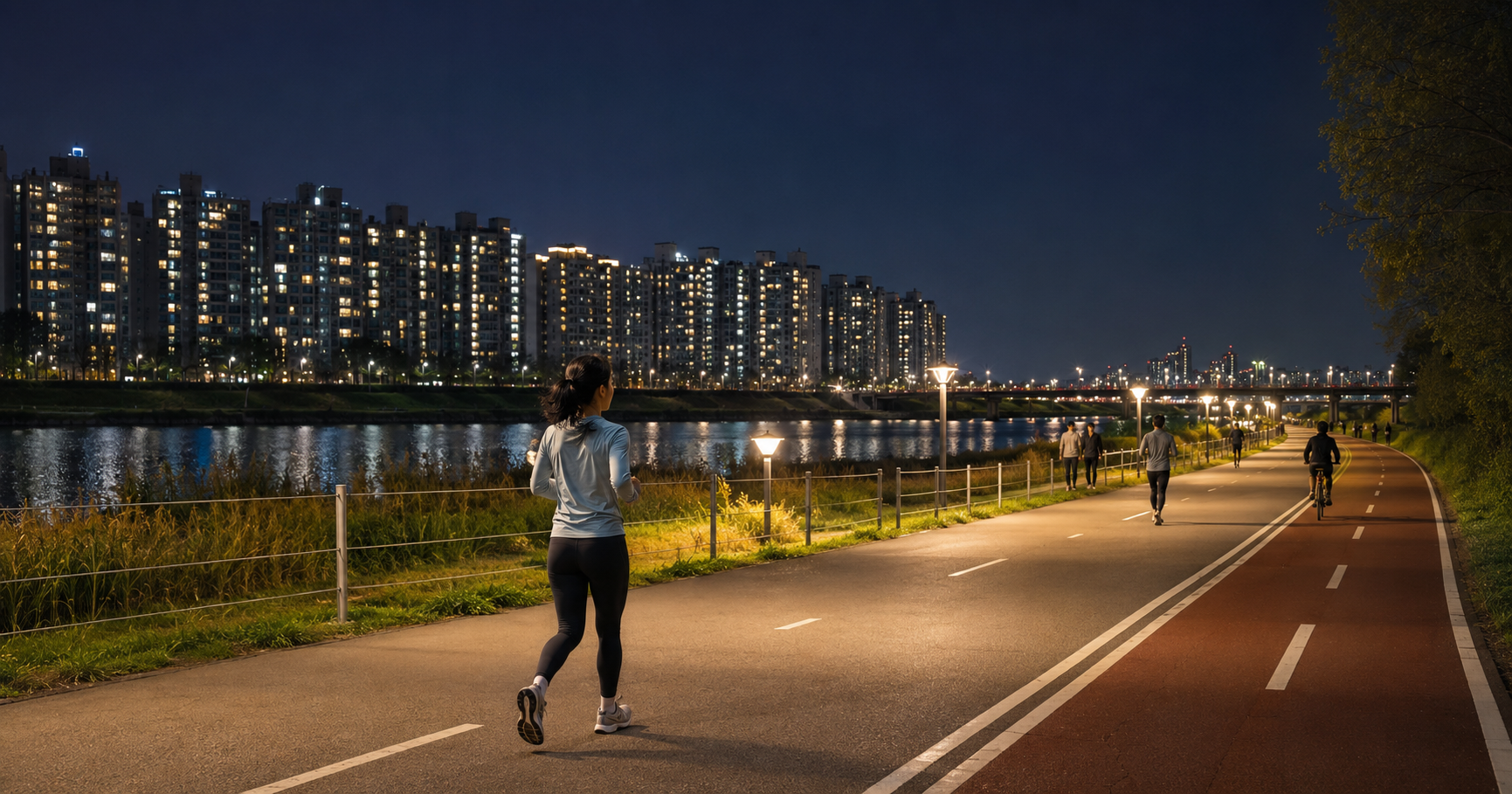

Would you feel comfortable going for a run alone at midnight—or even at two or three in the morning?
For many people, especially women, the answer would be no. In some cities, exercising alone after dark may feel too risky to consider.
That is why one everyday scene in South Korea still makes me pause, even after living here for more than fifty years: women running alone late at night.
I have completed several marathons and regularly train along riverside paths, sometimes long after sunset. During those years, I have never personally felt threatened while running or walking.
That experience does not mean crime never occurs in Korea. It does, and ordinary precautions still matter. Yet late-night exercise remains surprisingly normal in many busy Korean parks. Understanding why reveals something important about the way public space works here.
Late-Night Running in South Korea
In many Korean cities, well-lit paths, security cameras, nearby housing, and the continued presence of walkers, cyclists, and other runners help late-night public spaces feel active rather than abandoned. Conditions vary, but this combination allows many residents—including women running alone—to use popular routes well after dark.
The most important word here is active.
A riverside path at midnight may not feel empty. You may pass a cyclist, a couple walking after dinner, someone taking a dog outside, or a runner finishing a long training session. Convenience stores and apartment buildings may still be visible nearby.
No single feature guarantees safety. Together, however, these details can make a public path feel connected to ordinary city life rather than isolated from it.
A Scene That No Longer Feels Unusual
When I first began noticing women running alone at night, I might have wondered whether they felt afraid or thought they were unusually brave.
Those thoughts rarely occur to me now.
Instead, my reaction is much simpler:
“She must be training consistently.”
“I hope she has a good run.”
Perhaps that change in my own thinking says as much as the scene itself. When something happens repeatedly without attracting special attention, it becomes part of the accepted rhythm of daily life.
On the riverside paths where I exercise, a woman running alone after dark does not normally appear to be making a public statement about courage. She is simply exercising.
That distinction may surprise readers from places where an empty street after midnight carries a very different meaning.
Why Do Popular Running Paths Feel Different?
There is no single explanation for why many people feel relatively comfortable exercising late at night in South Korea. Several conditions work together.
Public Paths Are Often Well Lit
Popular riverside parks, streams, and neighborhood walking routes frequently have lighting along their main paths. Lighting does not prevent every incident, but it improves visibility and makes it easier for users to see other people and their surroundings.
Conditions can change quickly outside the main route. A bright riverside path may connect to a darker underpass, a quiet parking area, or a less-used trail. Runners should therefore judge each section separately instead of assuming an entire park has the same environment.
Other People Remain Outside Late
Korean urban life often continues well into the evening. Restaurants close late, public transportation operates beyond ordinary business hours, and many apartment neighborhoods remain visibly active.
In warmer months, people may deliberately postpone exercise until the air becomes cooler. At ten or eleven at night, a popular path can still have a steady flow of walkers and cyclists.
The presence of other people does not automatically make a place safe. It does, however, provide natural observation and reduce the feeling of being completely alone.
Housing Is Often Close to Recreation Areas
Many Korean walking and running routes pass through densely populated neighborhoods. Streams, parks, and bicycle paths may run beside apartment complexes, subway stations, shops, and major roads.
As a result, outdoor recreation is not always separated from residential life. Someone can leave an apartment, reach a path within minutes, exercise, and return home without traveling to a distant sports facility.
This proximity helps explain why the paths attract regular users before work, after dinner, and late at night.
Cameras and Safety Infrastructure Are Visible
Security cameras are common in many Korean urban public spaces. Seoul has also expanded intelligent surveillance cameras, emergency devices, and security lighting as part of its public-safety programs.
These systems should not be treated as an invisible shield. Cameras may assist monitoring or investigation, but they cannot guarantee immediate protection in every location.
Their presence can nevertheless contribute to the way residents perceive public space, especially when combined with lighting, maintenance, nearby housing, and regular pedestrian activity. The Seoul Metropolitan Government’s public-safety information also makes clear that blind spots and violent incidents remain genuine concerns.
More Than Fifty Years of Personal Experience
I have lived in South Korea for more than half a century.
During that time, I have walked countless streets after dark and covered many kilometers on riverside running paths. I am grateful that I have never personally encountered a situation in which I feared for my safety.
That is an individual experience, not a national crime statistic.
Another person may have had a very different experience. Safety can vary according to the neighborhood, time, lighting, crowd level, and individual circumstances. Women may also face risks and concerns that a male runner does not experience in the same way.
Still, long-term personal observation has value when its limits are clear. What I can honestly say is that late-night outdoor activity has remained a familiar part of the Korean cities I know.
I do not interpret every solitary female runner as fearless. I see her as a person completing an ordinary workout in a public space she has decided is comfortable enough to use.
Does This Mean South Korea Is Completely Safe?
No country is completely safe, and South Korea is no exception.
The current United States travel advisory assigns South Korea Level 1: Exercise Normal Precautions, but its detailed guidance also warns that a low overall crime rate can create a false sense of security. Sexual assault, theft, harassment, and other crimes can occur.
This balance matters.
Describing Korea as a place where many people feel comfortable outdoors late at night can be accurate. Claiming that nothing bad ever happens would not be.
Visitors should also avoid comparing entire countries too casually. Safety conditions can differ greatly among neighborhoods within the same city, and a familiar route used by hundreds of residents is not comparable to an unfamiliar, deserted trail.
The remarkable part is not that danger has disappeared. It is that many Korean public spaces remain active enough for late-night exercise to feel routine.
Practical Safety Tips for Night Runners
Visitors who want to run after dark should use the same judgment they would anywhere else.
- Choose a well-lit route with regular pedestrian or bicycle traffic.
- Check the entire route during daylight before running it at night.
- Avoid isolated underpasses, closed construction areas, and unlit trails.
- Keep your phone charged and know how to identify your location.
- Tell someone where you are going when running alone.
- Keep music low enough to hear bicycles, vehicles, and people approaching.
- Carry identification and only the valuables you need.
- Leave immediately if a place or person makes you uncomfortable.
- Pay attention to extreme heat, cold, rain, ice, and poor air quality.
- Remember that safety conditions differ by location and time.
In an emergency involving crime or an immediate threat, call 112 for the police. Call 119 for an ambulance or the fire service. International visitors can say “English, please” or “Interpreter, please” when connected, according to the Korea Tourism Organization’s emergency guidance.
Why Riverside Parks Stay Busy After Dark
Riverside spaces in Korea are more than running courses.
Depending on the location, they may include bicycle lanes, outdoor exercise equipment, sports courts, picnic lawns, cafés, convenience stores, playgrounds, and restrooms. Residents use these spaces for exercise, commuting, conversation, and relaxation.
Summer weather adds another reason for late activity. Korean summers can be hot and humid, so runners often wait until the sun has gone down. Even then, evening temperatures may remain high, making hydration and heat awareness important.
The result is a public space that changes rather than closes at night. Families and picnickers gradually leave, while walkers, cyclists, and runners continue to pass through.
A visitor who sees only the famous attractions of Seoul may miss this quieter side of the city. A late walk along a busy riverside path can reveal how closely recreation is woven into everyday urban life.
Freedom From Constant Anxiety
For me, this story is not really about marathon training or even about running.
It is about the freedom to enjoy an ordinary moment without constant anxiety.
Public safety is often discussed through crime statistics, police numbers, and surveillance systems. Those measurements matter, but daily experience also has a human dimension.
Can an older couple take an evening walk after dinner?
Can a worker clear her mind with a run after a long day?
Can a resident sit beside the river without feeling that darkness has made the entire park unusable?
In many Korean neighborhoods, the answer is often yes. That everyday confidence helps turn parks and riversides into shared living spaces rather than places people use only during daylight.
A Quiet Detail That Reveals South Korea
Visitors often try to understand South Korea through its palaces, food, technology, or popular culture. Those subjects are important, but a country also reveals itself through scenes that local residents barely notice.
One of those scenes is a woman running alone beside a river long after sunset.
She may be listening to music, following a training plan, or simply enjoying a cooler hour of the day. Other runners pass without staring. Cyclists ring their bells as they approach. Apartment lights remain visible beyond the trees.
It is not proof that Korea is free from danger. It is evidence that, in many places, public space remains part of ordinary life after dark.
Final Thoughts
After more than fifty years in South Korea, I still appreciate the sight of people exercising peacefully late into the evening.
I do not admire a solitary female runner because I assume she is risking her life. I admire her consistency. She is out there doing the work, one kilometer at a time, in a place where that choice can feel unremarkable.
Visitors should remain alert and make sensible decisions, just as local residents should. But they may also notice something quietly valuable: darkness does not always bring public life to an end.
Sometimes, understanding a country begins with a famous landmark. At other times, it begins by watching an ordinary runner disappear down a well-lit riverside path.
Official External References
- Seoul Metropolitan Government: Smart Public Safety
- Korea Tourism Organization: Emergency and Safety Services
- U.S. Department of State: South Korea Travel Advisory
Frequently Asked Questions
Is it safe to run alone at night in South Korea?
Many people use popular Korean parks and riverside paths after dark, but safety varies by location and time. Choose a well-lit, active route, remain aware of your surroundings, and avoid isolated areas.
Is it common to see women running alone at night?
It is a familiar sight on many busy urban running routes, especially during warm weather. However, personal comfort and local conditions differ, so it should not be assumed that every woman or every location feels equally safe.
Why are Korean parks active so late?
Dense residential neighborhoods, long urban schedules, illuminated paths, hot summer weather, and easy access to rivers and streams all contribute to late-night activity.
What number should tourists call in an emergency?
Call 112 for the police and 119 for fire or ambulance services. International visitors who need language support can request an English interpreter.
Are all Korean riverside paths well lit?
No. Major paths may have good lighting, while underpasses, side trails, and less-used sections can be much darker. Examine an unfamiliar route during daylight before using it at night.